3/26/2013

GO EAST!

 Gazprom, Russia's state gas provider, has been told to speed up exploration activities in the far east of the Federation.

Chief executive Alexey Miller told a high-level meeting that the Eastern Gas Programme, covering Siberia, needed to pick up speed.

The Sakhalin, Yakutia and Irkutsk gas production centers were all identified as locations for renewed effort.

In a statement on the Gazprom website, it was noted that in those regions the company had sufficient reserves to secure long-term gas supplies "for both Russian and foreign consumers".

The commercial reserves of the Eastern Gas Programme (EGP) at estimated at 5.2 trillion cubic meters (tcm).

In 2007 the Russian government approved the state-run Development Program for an integrated gas production, transportation and supply system in Eastern Siberia and the Far East, the EGP. China and other Asian-Pacific countries were seen as potential markets. Just this week Beijing and Gazprom signed a memorandum of understanding (MOU) on gas supplies via the eastern route.

2/04/2013

THE STREAM OF COSTS.

Russian gas giant OAO Gazprom said it would invest 509.6 billion Russian rubles ($16.89 billion) expanding its pipelines to take gas to southeastern Europe via the South Stream link, piling further costs onto a project aimed at bypassing traditional transit countries Ukraine and Belarus.

The investment in Russia's domestic pipeline network, revealed Tuesday in a document posted on Gazprom's website, will bring the total cost of the South Stream project—aimed at shipping 63 billion cubic meters of gas under the Black Sea by 2018—to $38.4 billion. The offshore and European sections of the pipeline are forecast to cost €16 billion ($21.53 billion).

Russia is building the South Stream pipeline to diversify supply routes to the European Union after disputes with Ukraine led to cutoffs in 2006 and 2009. Russian gas covers about a quarter of Europe's needs.

Analysts have long criticized Gazprom for perceived overspending on pipeline projects. Some analysts question the need for South Stream, given flagging demand for Russian gas in its most lucrative market in Europe.

"It looks expensive and unprofitable, as in the future Gazprom will have to pay for gas transit under 'supply or pay' terms, and it may not fully supply the pipeline," said Raiffeisen Bank analyst Andrey Polishchuk. "It's a risky project. The only reasons to build it are political, to decrease the risks related to transit through Ukraine."

Gazprom and its South Stream partners Électricité de France SA, BASF-Wintershall and Italy's ENI SpA launched construction of the offshore section of the pipeline in December.

12/20/2012

SOUTH STREAMING.

Russia's Gazprom said construction would begin this week on the underwater section of its South Stream pipeline, which will carry natural gas beneath the Black Sea and into the European Union.

But is this really the case?

Gazprom CEO Aleksei Miller announced last month that the final investment decision for the project had been reached. Miller attended a groundbreaking ceremony near the town of Anapa on Russia's Black Sea coast on December 7.

However, as Johnatan Stern, head of the Natural Gas Research Program at the Oxford Institute for Energy Studies notes, Gazprom hasn't yet ordered pipe or organized the lay barge for the pipeline and "cannot start laying the offshore section until 2014 [at the] earliest."

Moreover, EU officials say a final route has yet to be submitted to Brussels and likely won't have final approval for at least another year.

RFE/RL has also learned that EU Energy Commissioner Guenther Oettinger declined an invitation to attend the groundbreaking, citing previous commitments.

Marlena Holzner, the spokeswoman for the EU energy commissioner, says this means that a final investment decision on South Stream -- a phase after all designs and studies have been completed and official approvals are in hand -- isn't even in sight.

"We have no concrete information that, indeed, the final investment decision on South Stream has been taken already because normally, if you use this term in a general sense, you would have different things established before you can say it's a final investment decision," Holzner says. "And one is that you have the route.

"To the European Commission, it has never been communicated that there is a final route. That means where South Stream starts, where it ends, and which countries the exact route goes through. That has not been done," she continues. "There is no environmental impact assessment for the whole route. As far as we can see it, we don't regard this as a final investment decision."

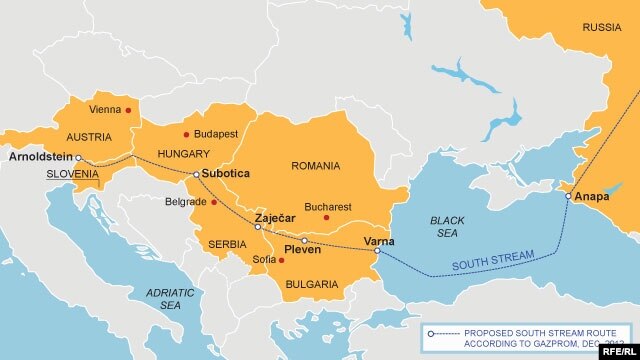
The proposed South Stream pipeline route, according to Gazprom
​​
Gazprom says South Stream will pass through Turkish waters to Bulgaria, then continue on through Serbia, Hungary, Slovenia, and Austria to tie in with the distribution network of the multinational Eni in northern Italy.

Officials in Brussels say they see South Stream's current status as moving from the "conceptual design and feasibility" stage to the "front-end engineering and design" phase.

In the latter phase, EU legislation requires numerous tasks that need approval from regulators in each country along the route and from the European Commission itself.

Russia says it has concluded intergovernmental agreements needed with each EU country involved, but the European Commission hasn't yet seen them all.

The deadline for EU states to submit those documents to Brussels is February 16, 2013. The commission then has nine months to assess the agreements and raise its doubts and concerns.

A detailed plan for the entire route must be submitted to Brussels, which also must approve environmental and social impact studies by national regulators in each EU country.

A "transboundary assessment" is also required, with input from EU states adjacent to the route. All studies require consultations with the public and authorities in each country and could take more than a year to complete.

Moreover, the offshore section of the pipeline entering Bulgaria must undergo an EU environmental-impact study to ensure it complies with environmental directives.

Russian-European Chamber of Commerce President Sergei Shuklin confirmed that the December 7 ceremony at Anapa will mostly be a ribbon-cutting affair without underwater construction activity.

"Yes, yeah, I agree with that. But it starts," Shuklin said. "Actually, by this action, Russia showed they are serious about this project. They are just going to make it happen. I'm pretty sure.... So they will have the first communications with the European Commission, with the governments of the countries participating in this project. So everything will be concluded [according to EU legislation], especially [since] Russia just became a member of the World Trade Organization."

So why did Gazprom rush to make its announcement?

Shuklin suggested it could be related to a probe launched in September by the European Commission into allegations that Gazprom engaged in anticompetitive practices in Central and Eastern Europe.


"Russia was actually surprised with the action related to Gazprom," he said. "And so probably, one of the reasons was, 'Yeah, let's just do it our way. We know people from the countries where we will build the pipe, and at this point, deal less with the European Union government.'"

Robert Cutler, a research fellow at Carleton University's Institute of European, Russian, and Eurasian Studies in Canada, maintains that Gazprom's push to announce the start of construction work on South Stream could also be related to domestic politics.

"On live Russian television, [President] Vladimir Putin gave [Prime Minister] Dmitry Medvedev a direct order: Construction of the pipeline should begin by the end of 2012," Cutler said. "There's a certain amount of prestige domestically invested now in producing some sort of result, even though physical construction of the pipeline probably was not in the cards then and certainly is not now.

"If Putin gives this order and Medvedev says, 'We'll do it,' but it doesn't end up happening, it raises questions domestically about their authority within the factions in the Kremlin and about Gazprom's credibility overall internationally."

According to Cutler, another reason is to give the appearance that South Stream is progressing faster than the Nabucco pipeline, a rival U.S.-backed project aimed at reducing Europe's dependence on Russian gas by linking the Caspian region and the Middle East to EU markets. 

11/08/2012

KLITSCHKO KALADZE AND THE ENERGY POLICY.(Klitschko, Kaladze e la politica energetica)


Klitschko. Più che un cognome, un marchio.

Vitali e Wladimir. 4 metri e un paio di quintali in due. Entrambi attualmente campioni del mondo dei pesi massimi. Una vita in giro per l’ex impero sovietico la loro, seguendo il padre aviatore dal Kirghizistan, dov’è nato Vitali, al Kazakistan, dov’è nato Wladimir, fino all’Ucraina, dove nell’86 il signor Klitschko guidò le operazioni di bonifica intorno alla centrale di Cernobyl.

Un romanzo perfetto. Politicamente molto spendibile. In più Vitali e Wladimir di acume tattico e strategico, sarà merito della boxe, ne hanno sempre avuto da vendere. Così un bel giorno, tra un incontro di pugilato, una partita a scacchi con il campione russo Kramnik e un dottorato di ricerca, nel più anziano dei due fratelloni (sottolineo, all’epoca 34 anni) sbocciò la passione per la politica. Era il 2005 e Vitali decise di candidarsi a sindaco di Kiev. Arrivò secondo, ma fu un’occasione per testare la buona fiducia di cui godeva.

Il suo programma, rimasto invariato sino ad oggi, era un miscuglio anche abbastanza contraddittorio di centrismo e populismo. Qualcosa di riassumibile in un classico “legge e ordine” ma con un’attenzione particolare ai diritti e alla pressione fiscale, da ridurre al più presto. Il tutto in un’ottica internazionale più interessata a Bruxelles e alla Nato che non a Mosca. Nel 2008, in occasione di una nuova campagna elettorale, il buon Vitali arrivò a scomodare addirittura Rudy Giuliani, il sindaco dell’11 settembre. Boxe, ring, legge, ordine, lotta al terrorismo e alla criminalità, sudore e canotte bianche: più che una piattaforma elettorale, una locandina di Die Hard.

Va da sé che con idee simili Vitali Klitschko abbia poco da spartire con l’attuale presidente ucraino Janukovic. E con una Yulia Timoshenko ancora in carcere per abuso d’ufficio, il “dottor Pugno di Ferro” (così è simpaticamente chiamato Klitschko) ha ben visto uno spazio di manovra per tentare di rottamare un sistema che, dopo soli due anni, per tanti ucraini puzza già di stantìo.

Per tanti, ma non per tutti. Le elezioni parlamentari, una vera e propria verifica di medio termine per Janukovic, hanno indicato una sostanziale tenuta del suo Partito delle Regioni, che si conferma la prima formazione del paese. Subito dietro il partito orfano della Timoshenko, alla quale la Corte Suprema aveva impedito di candidarsi. Quarto classificato il nostro Klitschko con il suo partito Udar (traducibile con “Colpo”, un po’ monotematico il ragazzo). Udar andrà così a ingrossare, insieme a nazionalisti, timoshenkisti e comunisti, le fila dell’opposizione.

Disastro totale dell’altro sportivo aspirante rottamatore Andriy Shevchenko. Sognava di imitare il suo vecchio allenatore Oleh Blokhin, eletto per due mandati consecutivi al parlamento di Kiev, e invece niet. Avanti Ucraina!, il partito che lo candidava, non ha superato la soglia di sbarramento. In più i forum ucraini hanno riservato al povero Andriy epiteti che vanno da “traditore” a “venduto”. Un successone. Come ci conferma la vicenda Klitschko, la politica da quelle parti è una cosa da duri. Riprendendo un tweet di Enrico Bertolino: non basta un pallone d’oro nel passato, servono due palle nel presente.

Calciatori prestati, o meglio regalati, alla politica. Sportivi con la rottamazione nel sangue. Già, perché quando sei abituato a muoverti all’interno di regole e a rispettarle vorresti che lo stesso accadesse per chi è alla guida del tuo paese. Piccolo corollario: gli scandali nel calcio in Italia non sono casuali. Sono solo l’ennesimo sintomo di ciò che ormai è evidente a tutti. Tranne che ai politici.

Detto questo, che poi il politico-sportivo non abbia spesso alcuna competenza in senso stretto è un fatto. Trascurabile, secondo il neo-premier georgiano Ivanishvili, che ha affidato all’ex milanista Kaladze il posto di vicepremier con delega all’energia, un qualcosa che in un paese come la Georgia significa praticamente il controllo assoluto. Cercare su google alla voce “oleodotto Baku-Tibilisi-Ceyhan”.
Stupito, emozionato, incredulo, Kakha Kaladze ammette in sostanza di non capirci un’acca né di energia né di oleodotti e gasdotti. Per cui davanti alle incalzanti domande tecniche si rifugia in un generico e forse un po’ torbido “ho tanti contatti all’estero che torneranno utili”. Ok, non vogliamo saperne di più.

Insomma, la rottamazione di un sistema può avvenire anche attraverso l’immagine, attraverso un volto noto e accattivante. Ormai lo abbiamo capito pure noi. Esistono le menti, esistono gli spin doctor. Ormai conosciamo i Casaleggio e i Gori. Kaladze e Schevchenko come George Weah, candidato presidente in Liberia. Kaladze e Schevchenko come Cafu, oggi sottosegretario allo sport in Brasile. Ma a Milanello, ogni tanto, ci si allenava?

6/22/2012

THERE MUST BE GAS. (Ci deve essere gas)

Poland’s hopes of hitting a shale gas bonanza have suffered a blow as ExxonMobil ended exploration for the unconventional fuel after tests failed to find gas in commercial quantities.

The US oil major said there had been “no demonstrated sustained commercial hydrocarbon flow rates” in two test wells in eastern Poland and added that it had “completed its exploration operations in Poland”.


ExxonMobil has six concessions in Poland and it remains unclear what plans the company has for them.

The decision by ExxonMobil is the latest in a series of disappointments over Poland’s possible gas reserves.

Energy companies and the government were enticed by an estimate last year from the US Energy Information Administration, which said Poland might hold 5.3tn cubic metres of shale gas – the largest reserves in Europe.

However, a newer estimate by Poland’s government geological institute cut about 90 per cent off that, suggesting reserves of 346-768bn cubic metres.

Although the lower number is unlikely to turn Poland into a gas exporter, it would make it much less dependent on gas imports from Russia, which currently supplies about two-thirds of the 14bn cubic metres of gas the country consumes annually.

Waldemar Pawlak, Poland’s economy minister, suggested that ExxonMobil became less interested in its Polish operations after agreeing last week to develop tight oil reserves in Siberia together with Rosneft, the Russian state oil group.


“With such prospects, shale gas in Poland did not have as much meaning for [ExxonMobil],” said Mr Pawlak.

In 2009, ExxonMobil abandoned shale gas exploration in Hungary after a disappointing result from a test well.

The Polish government has handed out 109 shale gas exploration concessions around the country, and the other companies still looking for the fuel – a process that involves pumping fluids at high pressure deep underground to fracture rock, releasing trapped oil and gas – are still optimistic about Poland’s possible deposits.

Companies active in Poland include Chevron, ConocoPhilips and Poland’s PGNiG, the former gas monopoly, as well as a host of smaller groups specialised in shale gas exploration.

“I’m a bit perplexed as to why anyone would drill just two wells and then leave,” said John Buggenhagen, exploration director for Aim-quoted San Leon Energy, which has concessions near the Baltic coast, as well as in the west and south of the country.

“We believe it will take dozens of wells to explore just a small area. San Leon believes Poland has huge potential.”

One of the earliest tests came from 3Legs Resources, the UK-based independent that was the first operator to drill and test two shale wells near the Baltic coast where it found “encouraging” quantities of gas, although the flow rates were less than expected.

Mikolaj Budzanowski, the treasury minister, estimates that the first commercial shale gas extraction should begin in 2014-2015, with about 0.5 to 1bn cubic metres coming to market initially, with production eventually ramping up to 5bn-10bn cubic metres a year.

Poland has been one of the most enthusiastic backers of shale gas in the European Union, while other countries such as France, Romania and Bulgaria have instituted moratoriums on shale exploration for environmental reasons.

4/12/2012

"BOYKOS COME AND GO". (I Boyko vanno e vengono)

Russia has reiterated its determination to construct the Burgas-Alexandroupolis oil pipeline and reduce the price tag of the project, following Bulgaria's withdrawal.

This was confirmed by Trans-Balkan Pipeline consortium advisory board member Mikhail Barkov, as cited by RIA Oreanda-News.

Russia will insist on executing the Burgas-Alexandroupolis project given minimization of costs on it, Barkov said.

The agreement to build the oil pipeline was signed in 2008, but at the end of 2011 Bulgaria revealed it is giving up on the project, and paid the Russian and Greek sides the needed dues.

In the interview, Barkov stated that the Burgas-Alexandroupolis pipeline, which will diversify ways to bring oil from the Black Sea to the Mediterranean, will outlive political passions.
Referring to Bulgaria's Prime Minister Boyko Borisov, Barkov recently famously said that "Boykos come and go, but Bulgarians' love for Russia is for ever."

The Bulgarian government said in December last year that it will leave the project, which involved building a pipeline through Bulgaria and Greece to transport Russian oil from the Black Sea to the Aegean, bypassing the Bosphorus.

The government said it is quitting the project as not economically efficient, after months of sending negative signals as to its commitment to it.

Bulgaria's Finance Minister Simeon Djankov has expressed confidence that the withdrawal will not force the country to pay anything more than its EUR 6 M outstanding dues on the project, which accrued during its advance financing. The sum was transferred at the beginning of February 2012.

Russia has insisted on preserving the existence of a company to manage the project in the long term.

At the present moment, Bulgaria's position calls for a cancellation of the intergovernmental agreement to build the pipeline, while Greece supports the Russian stance.
(TurkishWeely)

2/06/2012

INTERNAL MARKET FIRST. (Prima il mercato interno)

Gazprom said on Saturday it could not pump additional gas to Western Europe amid a cold snap, after EU officials and energy firms said the Russian giant's deliveries had dropped in several states.

"Gazprom at the moment cannot satisfy the additional volumes that our Western European partners are requesting," the company's deputy chairman Alexander Kruglov said at a meeting with Prime Minister Vladimir Putin, according to Russian news agencies.

Putin told Gazprom at the meeting that the demands of Europe had to be respected but the firm's priority was to supply consumers in Russia, which is also enduring a spell of very cold weather.

"I ask you to make efforts to meet the demands of our foreign partners, bearing in mind that the prime task of Russian energy firms and Gazprom in particular is to satisfy the internal demand in Russia," said Putin.

"This is the priority task."

Kruglov said that Gazprom was carrying out deliveries in line with its agreements with European states but that it was unable to pump additional gas that had been requested.

He said there had been a reduction of 10 percent in gas volumes delivered on previous days but that now deliveries had returned to their normal levels.

The European Commission said Friday that Austria, Bulgaria, Germany, Greece, Hungary, Italy, Poland, Romania and Slovakia had each registered drops in gas supplies.

But a spokeswoman for EU energy commissioner Guenther Oettinger, Marlene Holzer, had said that Gazprom contractual small print with European buyers "allows for a certain flexibility."

German energy giant RWE said it was currently receiving 30 percent less gas from Russia than is foreseen in contracts.

"Supply for clients is however assured, notably due to well filled stocks," a spokesman said, adding there would be no problem in the days to come.

Its main rival E.ON, which obtains 27 percent of its gas annually from Gazprom, said it was "well-armed against reductions in supply from Gazprom", even if demand was high for a long period, due to high stock levels.

Russian gas amounted to 33 percent of Germany's supplies in 2010, its main source of gas imports ahead of Norway with 29 percent.

The economy ministry of the Netherlands meanwhile said the country produced sufficient gas itself and had sufficient reserves "to face all the needs".

"We have other possibilities of supply," said spokeswoman Esther Benschop, saying the country had "great flexibility" in gas.

Austria on Friday had logged a 30 percent fall in Russian deliveries and Italy had seen deliveries fall by 24 percent. Deliveries to Italy's gas network Snam Rete Gas were down 28.9 percent on Friday.
(JakartaGlobe)

12/20/2011

KAZAKH OIL WORKERS PROTEST.(Gli operai del settore petrolifero kazako protestano)

Holding signs with the slogan, “Don’t Shoot the People,” hundreds of oil workers in the city of Aktau in western Kazakhstan protested today against a recent police crackdown on striking workers, the New York Times reported. Clashes with police on Dec. 16 and Dec. 17 caused the deaths of at least 14 striking workers and wounded dozens more.
Thousands of oilmen had been on strike in the Mangistau region since May, demanding wage increases, Reuters reported. On Friday in the city of Zhanaozen, police fired on protesters in the central square, killing at least 13, the New York Times reported.

According to the New York Times:
The workers in Zhanaozen appear to have grown angry when officials began installing holiday decorations for a government-sponsored children’s party, which they felt was a ruse to remove them from the square, witnesses said. Officials said the police were forced to open fire after they came under attack by “hooligans,” some armed with stones and gasoline bombs.

Interior Minister Kalmukhambet Kasymov said the police had no choice but to fire their weapons, The Associated Press reported. “Nobody specifically gave the order to open fire in that situation,” he told the AP. “Every police officer took the decision themselves. When they take a weapon off you, there is no need for an order to be issued.”

After the clash in the square, Kasymov said, the crowd raged throughout the city, setting fire to the mayor’s office, a hotel, the UzenMunaiGas oil company headquarters and the local branch of the governing Nur Otan party.

On Saturday, one person was killed when police fired on several hundred protesters who blocked railroad tracks in the nearby city of Shetpe, the New York Times reported.

The Organization for Security and Cooperation in Europe chairperson-in-office, Lithuanian Foreign Minister Audronius Azubalis, expressed dismay at the way the situation was handled, the AP reported. “Any action to control crowds by law enforcement should be proportionate and in line with international human rights standards,” he said in a statement.
On Dec. 17, Kazakhstan’s President Nursultan Nazarbayev declared a three-week state of emergency for Zhanaozen, the AP reported.
(GlobalPost)

Qui il link al sito dei manifestanti Campaign Kazakhstan.

11/08/2011

RUSSIA-UKRAINE = 1-0

Entrerà in funzione oggi, martedì 8 novembre, North Stream, la pipeline che porterà il gas russo in Germania attraverso il Baltico. Dmitrij Medvedev e Angela Merkel hanno “accolto” quel gas in Germania, a Lubmin, girando il rubinetto che gli ha aperto la rete europea. Alla cerimonia hanno preso parte anche il primo ministro francese, François Fillon, il collega olandese Mark Rutte e il commissario europeo all’Energia, Gunther Oettinger: Francia e Olanda sono gli altri due Paesi che aderiscono al consorzio, diviso tra Gazprom, le tedesche Wintershall e E.On Ruhrgas, l’olandese Gasunie e la francese Gdf Suez.

“I consumatori europei potranno avere fino a 55 miliardi di metri cubi di gas dalla Russia nei prossimi anni con il lancio della seconda condotta del North Stream – ha affermato Medvedev in una conferenza stampa congiunta con la Merkel a Berlino – il gas naturale russo e l’elettricità prodotta con essa garantiranno una fornitura energetica stabile ai consumatori del continente e aumenteranno la loro sicurezza energetica”. Il primo tratto pomperà 27,5 miliardi di metri di cubi di gas all’anno, circa la metà di quella che sarà la capacità definitiva della struttura. North Stream parte da Vyborg, nei pressi di San Pietroburgo, e termina a Lubmin, in Germania.

North Stream è lungo 1.224 chilometri e ha ora una capacità di trasporto di 27,5 miliardi di metri cubi all’anno, che diventeranno 55 con la costruzione di una seconda linea, attesa per l’autunno 2012. Il monopolio russo Gazprom ha già siglato contratti di fornitura a lungo termine con diversi Paesi europei, inclusa la Germania, la Danimarca, il Belgio, l’Olanda, la Francia e la Gran Bretagna. In attesa che South Stream colleghi invece la Russia all’Europa meridionale, sempre con l’obiettivo di ridurre i volumi del gas russo – finora l’80% – esportato in Europa attraverso l’Ucraina.
(East Journal)

10/20/2011

TYMOSHENKO, THE BIG BLUFF. (Tymoshenko, il grande bluff)

Far fuori gli avversari politici mettendoli dietro le sbarre non è certo il metodo migliore per gestire il potere ottenuto in maniera democratica. Eppure è quello che sta succedendo in Ucraina con il caso di Yulia Tymoshenko, ex primo ministro e leader dell’opposizione che è stata condannata a sette anni di galera per abuso di potere.

Al presidente Victor Yanukovich la dura sentenza serve anche per ottenere una piattaforma giuridica per tentare di ottenere la revisione dei contratti del 2009, obiettivamente svantaggiosi per il paese. Si spiega in questa maniera la reazione russa, con il Cremlino che sia durante il procedimento sia alla sua conclusione si è schierato a favore dell’imputata, sottolineando la validità degli accordi raggiunti tra l’eroina della rivoluzione arancione e Vladimir Putin due anni fa.
I rapporti tra Kiev e Mosca sono sempre passati attraverso le pipelines: è l’oro blu a unire o dividere, a seconda dei momenti. E i protagonisti di queste storie sono sempre gli stessi. In Ucraina Yulia Tymoshenko, ex principessa del gas che con il suo gruppo ha gestito per anni il traffico con la Russia e che prima è passata al ministero dell’Energia poi alla seggiola di premier; Dmitri Firtash, oligarca impegnato nell’energia e non solo, nemico giurato della bionda pasionaria; Yuri Boiko, attuale ministro dell’Energia, ex ceo a Naftogaz e uno dei suggeritori di Yanukovich, da anni schierato con l’ala conservatrice uscita dal blocco dell’ex presidente Leonid Kuchma cui appartengono gli altri magnati dell’industria ucraina, guidati da Rinat Akhmetov.

In Russia chi controlla Gazprom, cioè il Cremlino, è il vero gestore delle relazioni che toccano economia e politica: Putin impera. E se l’ormai scomparso Victor Chernomyrdin dopo essere stato per anni il numero uno di Gazprom era stato mandato a fare l’ambasciatore in Ucraina lo scorso decennio il motivo era chiaro. Politica e gas: gli intrecci al Cremlino sono come quelli alla Bankova e interpretarli non è sempre cosa semplice: ma è chiaro che il processo Tymoshenko si inserisce nel canovaccio dei duelli per il potere.
L’Europa in questa contesa fa da spettatrice: non ha danari per intraprendere un progetto consistente per la ristrutturazione del gas ucraino e rischia di lasciare via libera alla Russia che, avviato Nordstream, ha ora Southstream in progetto. Il sistema di trasporto ucraino va modernizzato e Gazprom vuole metterci sopra le mani, sul modello bielorusso (lo stesso dicasi per Naftogaz). Bruxelles si allarma per la Tymoshenko, ma non può permettersi di abbandonare i negoziati sull’accordo di associazione che dovrebbe essere firmato entro l’anno con Kiev.
L’errore europeo è stato quello di non capire che la rivoluzione del 2004 era un bluff. Gli ucraini l’anno capito da tempo, basta andare a guardarsi i sondaggi sul gradimento della Lady di ferro, peggiori di quelli di Yanukovich. Ora rischia di essere troppo tardi.
(Limes)

8/16/2011

RUSSIA AND THE KOREAN - GAS - UNITY. (La Russia e l'unità coreana ... del gas)

South Korean and Russian press are reporting on talks between officials from Russia and South and North Korea on construction of a gas pipeline along the Korean Peninsula.

South Korean Foreign Minister Kim Sung-hwan, just back from a visit to Moscow, said on August 12 that Gazprom and the Russian Foreign Ministry are in contact with North Korean officials about the possibility of building a pipeline from Russia to South Korea via North Korea.

Russian Foreign Minister Sergei Lavrov has been quoted as saying North Korea was "positive" about the idea.

Gazprom and South Korean company KOGAS signed an agreement for Russian gas in 2008, but
that deal envisioned Russia shipping liquefied natural gas from Sakhalin Island.
(Rferl)
----------------------------------------------------------------------------------

North Korea says it has received a message from Russian President Dmitry Medvedev seeking cooperation on the construction of a gas pipeline from Russia, through North Korea to South Korea.

Pyongyang’s official KCNA news agency said Monday the message also proposed connecting railways and power lines across the three countries. It said the message was delivered to mark the anniversary of the end of Japanese colonial rule on the Korean peninsula.

Russian Foreign Minister Sergei Lavrov was quoted last week saying North Korean officials had responded favorably during initial discussions about the pipeline project. South Korea has contracted to purchase huge amounts of natural gas from Russia later in this decade, and a pipeline through North Korea would substantially reduce delivery costs.

For North Korea, the deal presents an opportunity to acquire vital hard currency by charging transit fees. However South Korea has been reluctant to enter into similar deals in the past because of its often hostile relationship with Pyongyang. Any such system could be disrupted during a future dispute.

KCNA quoted Mr. Medvedev’s message saying Russia is willing to boost cooperation with North Korea “in all directions of mutual concern.” The message said these included a “three-party plan” in the fields of gasification, energy and railway construction.

There have already been preliminary discussions of a rail line that would run from South Korea and connect to the trans-Siberian railroad, making it possible to travel by train from Seoul to Europe.
(Voice of America)

6/03/2011

RUSSIAN CUCUMBERS. (Cetrioli alla russa)

Dunque dopo la mucca pazza, la Sars, l’aviaria e la suina è arrivato il cetriolo killer. Le vittime causate da questa variante del batterio Escherichia Coli sono certamente tante, sempre troppe. Tuttavia, anche stavolta, il rischio è che a livello mediatico venga instillata la psicosi collettiva della pandemia. Insomma, abili operazioni di spin a vantaggio dei soliti noti, case farmaceutiche in testa.

Nel frattempo accadono due cose. Anzitutto i paesi europei si scannano come al solito tra loro, accusandosi l’un l’altro d’aver dato inizio al contagio. Zapatero ha già chiesto a Berlino un risarcimento di almeno 200 milioni di euro per il danno economico d’immagine provocato dalle insinuazioni tedesche. Dal canto suo la Russia, e questo è il secondo aspetto rilevante, ha pensato bene di chiudere temporaneamente le proprie frontiere agli ortaggi comunitari. Proprio così, a tutti gli ortaggi, dal momento che non si è ancora sicuri dove risieda effettivamente questo batterio killer.

Ovviamente a Bruxelles si è gridato al sacrilegio. Frederic Vincent, portavoce del commissario alla salute dell'Unione Europea s’è affrettato a definirla una “misura sproporzionata”. Proporzionatissimo era invece il blocco alle importazioni di pollame proveniente dalla Russia deciso dalla Commissione Europea ai tempi dell’aviaria. Due pesi e due misure. Ma si sa, noi europei abbiamo la memoria corta, anzi cortissima.

Il fatto è che sul piatto della contesa non ci sono solamente gli ortaggi. Anche per i poderosi stomaci russi i cetrioli possono essere particolarmente indigesti. Ma ancora più indigeste possono essere le liberalizzazioni energetiche, come quella contenuta nel “terzo pacchetto” Ue che prevede la separazione tra produzione e distribuzione. Unbundling è il termine tecnico.

Angry è invece stata la reazione di Putin al vertice energetico Russia-Ue dello scorso febbraio. Il terzo pacchetto è senza dubbio un pugno al ventre delle ambizioni di Mosca di tener ancorato a sé, per mezzo dei tubi, il Vecchio Continente. Per il momento inutili i tentativi del premier russo di far leva sugli accordi energetici siglati con i singoli stati dell’Unione, così come inutile è apparso il tentativo di convincere Barroso del rischio di un aumento dei prezzi affidando le reti di distribuzione a piccole compagnie alternative a Gazprom.

È noto che tra Putin e Barroso non scorra buon sangue. Alcuni file di Wikileaks non fanno che confermare quanto già risultava evidente ai tempi della crisi georgiana del 2008, quando il presidente della Commissione Europea minacciò di cessare l’acquisto europeo di gas russo se Mosca non avesse interrotto immediatamente le operazioni militari. Com’era prevedibile il messaggio entrò da un orecchio di Putin ed uscì subito dall’altro suo orecchio: in attesa dei gasdotti made in Usa che bypasserebbero il territorio della Federazione, per l’Ue il gas russo è semplicemente irrinunciabile.

Al contrario l’unbundling è per Putin una minaccia seria. Una misura che rischia veramente di allentare i cordoni di Mosca sull’Unione Europea. Un fattore di disturbo per la politica russa del “cortile di casa” est europeo.

Perciò Il blocco alle importazioni di ortaggi europei non può che essere interpretato anche come una ritorsione alle misure energetiche decise da Bruxelles. Una vendetta, che come si sa, è un piatto che va servito freddo. Senza l’ausilio di un fornello a gas.
Proprio come i cetrioli alla russa.

Ingredienti : cetrioli - sale - pepe - olio - aceto - prezzemolo - crema di latte.

Mondate i cetrioli e ritagliateli in fette finissime. Raccogliete queste fettine in una piccola insalatiera e cospargetele con un po' di sale fino, per privare il cetriolo della molta acqua di vegetazione che contiene.
Dopo una mezz'ora prendete un po' di fette alla volta, strizzatele e spandetele sopra un tovagliolo che poi arrotolerete pian piano.
Le fettine così rinchiuse si asciugano perfettamente.
Dopo un altro po' di tempo accomodate le fettine nei piattini da antipasto, conditele con pochissimo sale, pepe, olio, aceto e prezzemolo trito, aggiungendo una cucchiaiata o due di crema di latte sciolta.
Mettete i piattini preparati in frigo per almeno un'ora, affinché i cetrioli possano essere serviti freddissimi.
(Pubblicato su 24Emilia)

4/20/2011

AT FULL SPEED! (A tutto gas!)

Il Primo Ministro slovacco Iveta Radicova e il suo omologo ungherese Viktor Orban hanno firmato oggi a Bratislava un accordo internazionale su un collegamento gas transfrontaliero. Un accordi di programma era stato sottoscritto già il 19 Gennaio scorso dai Sottosegretari dei due Ministeri dell‘Economia, Martin Chren per la Slovacchia e Pal Kovacs per l‘Ungheria, e successivamente approvato dal Governo slovacco il 26 Gennaio.
Il collegamento tra Slovacchia ed Ungheria rientra nel più ampio progetto di corridoio nord-sud del gas, composto di diversi singoli progetti interconnessi. Il corridoio nord-sud si connetterà ai terminali di gas in Polonia e Croazia, e quindi il gasdotto attraverserà tutti i Paesi del Gruppo di Visegrad (V4), dunque anche Slovacchia e Ungheria. La Slovacchia sta i questo modo cercando di ridurre i rischi associati a possibili interruzioni delle forniture di gas dalla Russia, cosa che portò nel Gennaio 2008 ad una crisi del gas che mise a rischio non solo il riscaldamento delle abitazioni, ma anche la produzione di non poche aziende.

L’operatore slovacco Eustream di trasporto del gas ha già avviato colloqui con la sua società partner ungherese Foldgazszalito Rt per la redazione del rispettivo accordo commerciale e dettagli tecnici. Analogo accordo sarà fatto con la Polonia, con il cui operatore di rete GAZ-System è stata firmata una lettera di intenti pochi giorni fa.

L’accordo di oggi significherà un maggior grado di indipendenza in termini di sicurezza energetica della Slovacchia, nonché quello di tutta l’Unione Europea, ha affermato il Premier slovacco Iveta Radicova dopo la firma.

Secondo la Radicova, ci sono altre aree nelle quali i due Paesi possono migliorare. «Abbiamo sollevato il problema del collegamento delle reti elettriche, e abbiamo concordato con il Premier [Orban] che porteremo avanti un accordo in questo settore simile a quello del gas», ha detto, specificando che lo ritiene un obiettivo strategico. Tra gli altri temi discussi, la prevista ripresa dei lavori di costruzione della strada che collega la R4 nella Slovacchia orientale con l‘Ungheria. «L’Ungheria ha deciso di riprendere i piani per la superstrada tra Kosice e Miskolc», ha detto Orban, aggiungendo che intende trovare un accordo con la Slovacchia anche per il nuovo ponte nei pressi della città di confine di Komarno (regione di Nitra).
(Buongiorno Slovacchia)

3/17/2011

RETURNING TO OIL. (Tornare al petrolio)

The devastating earthquake and tsunami in Japan will temporarily take pressure off of tightening global oil supplies as the world's third-largest oil consumer works to rebuild its shaken economy, energy analysts said Monday.

But the disaster won't curb its energy appetite for long. Analysts say Japan will likely boost imports of coal, natural gas, diesel and other refined fuels in coming weeks.

"Demand for petroleum products is going to soar," analyst and trader Stephen Schork said.

Benchmark West Texas Intermediate for April delivery added three cents to settle at US$101.19 a barrel Monday on the New York Mercantile Exchange. It had fallen below US$99 earlier in the session.

In London Brent crude lost 17 cents to settle at US$113.67 a barrel on the ICE Futures exchange.

Oil prices had been surging in recent weeks because of events in North Africa, including unrest in Libya forced that country to shut down its oil fields, which had been producing about 1.6 million barrels of crude per day.

The squeeze on world supplies and concern that uprisings could spread across the Middle East have helped push oil prices about 24 per cent higher in the past few weeks.

Friday's earthquake and tsunami in Japan pulled markets in the opposite direction. Japan imports and consumes more than four million barrels of oil a day. Analysts say at least some of that will be reduced as steel plants, auto manufacturers and three of five major oil refineries temporarily shut down.

Some parts of northeastern Japan are still without power, and authorities are trying to stabilize damaged nuclear plants that have been taken off-line.

Japan has increasingly relied on nuclear power as it focused on weaning itself off of petroleum, like other industrialized countries. Of the total 22.3 quadrillion Btu Japan consumed in 2008, 11 per cent was generated by nuclear power plants. The U.S. consumed more than four times as much power, about eight per cent of it from nuclear energy.
Analysts think Japan will compensate for the shutdown of its nuclear reactors by relying more heavily on traditional fossil fuels. It can choose from a variety of sources. Most of Japan's energy is produced by power plants fired by coal, most of it from Australia. It burned 37,500 tons of coal in 2009. Japan also consumed 3.3 trillion cubic feet of liquefied natural gas that year, imported mainly from Indonesia, Malaysia and Australia.

Japan also operates natural gas-burning generators and a number of aging, oil-fired plants that can be cranked up during peak times. The Japanese may favour using more oil instead of natural gas in the short term, according to Michael Lynch, president of Strategic Energy & Economic Research. Lynch said there are more tankers available to deliver crude than LNG and more dedicated facilities in Japan that can accept oil imports.

"Oil is much easier to import," Lynch said. He added that Japan could boost crude imports by about 300,000 barrels per day while its energy infrastructure is hampered by the loss of nuclear power.

Japan's trade minister said Monday that the government will release enough oil from the country's reserves to cover three days of demand, according to Platts, the energy information arm of McGraw-Hill Cos.
Japan imports most of its oil from Saudi Arabia and the United Arab Emirates. Analysts say Japan will try to tap those sources for more oil, and it will look to the U.S. and India for more refined fuels like diesel.

"The U.S. still has a surplus of both gasoline and distillate supplies with which to meet any such upswing in export activity," energy consultant Jim Ritterbusch said.

Natural gas for April delivery gained 2.5 cents to settle at US$3.914 per 1,000 cubic feet. Earlier in the day, it climbed to the highest level in a month at US$4.053.

In other Nymex trading for April contracts, heating oil added 3.48 cents to settle at US$3.0638 a U.S. gallon (3.78 litres) and gasoline futures lost 2.74 cents to settle at US$2.9603 a gallon.
(The Western Canadian Pipeline)

2/09/2011

THE ORIGINAL PURPOSE. (Lo scopo originale)

Ukrainian President Viktor Yanukovych clinched energy pacts with Azerbaijan on Jan. 28 and attacked Russia for plans to bypass his country in supplying gas to Europe, reviving market fears of regular spats between Moscow and Kyiv.

Markets were relieved when Yanukovych, perceived as friendlier to the Kremlin than his predecessor, Viktor Yushchenko, was elected Ukraine’s president last year.

That followed five years of disputes between the ex-Soviet neighbors, marked by mid-winter cuts in Russian gas supplies to Europe that represent a quarter of the continent’s total needs.

But Yanukovych has played a much less pro-Moscow role than expected since taking office, saying the European Union was an equally or even more important partner than Russia.

Speaking at the World Economic Forum in Davos, the president lashed out at new Russian pipeline projects and signed oil and gas deals with Azerbaijan to cut Ukraine’s reliance on Russia.

Yanukovych said Ukraine shared Poland’s concerns about political motives behind the Nord Stream pipeline to supply Russian gas to Western Europe along the Baltic Sea floor, bypassing central European nations.

“Another project being discussed today between Russia and Europe is the construction of South Stream. This possibility is directly related to Ukraine and here I share the position of Poland,” he said, referring to a project to pipe gas under the Black Sea to southern Europe.

Russia ships about 80 percent of its gas exports to Europe through Ukraine now and the remaining 20 percent via Belarus and says it needs the new projects to boost Europe’s energy security after disruptions in previous years.

Yanukovych said South Stream would cost $25 billion while it would cost much less to upgrade Ukraine’s pipeline system.

“Why are our partners today pretending that there is no alternative? A year ago we proposed a project that would cost five times less – not more than $5 billion, it would come to the same destination points to which South Stream would go.”

“That’s why we ask the same question, speaking eye-to-eye with our partners, and we are still waiting for an answer.”

“If this is a way to exert pressure, not a commercial project, then of course serious questions arise about how we should build our relations today, let alone in the future.”

Yanukovych used the Davos platform to sign a deal with Azeri President Ilham Aliyev to import liquefied natural gas to a planned Ukrainian terminal aimed at reducing the country’s heavy dependence on Russian gas. The memorandum did not specify volumes for the terminal to be opened in 2015. He also signed a memorandum on cooperation in shipping Azeri oil across Ukraine.

Yanukovych said Ukraine would ship the first million tons of Caspian Sea oil to Europe via the pipeline this year, thus ending its use to export Russian crude to the Mediterranean.

“The Odessa-Brody pipeline has been used in various directions. Very soon we will start working according to the original idea, delivering oil from Odessa to European countries,” he said.

Interfax news agency quoted Ukrainian officials as saying the deal covered deliveries of up to 4 million tons a year.

Aliyev, who spoke at the same panel, said he was under no pressure from Russia to shun the Nabucco pipeline, seen as a key European Union’s attempt to reduce reliance on Russian.
(Therearenosunglasses's weblogs)

12/16/2010

SERBIA WILL PROBABLY MANTAIN OIL MONOPOLY. (Probabilmente la Serbia manterrà il monopolio petrolifero)

Private oil traders want to conclude an agreement with Naftna industrija Srbije for the period of three years, according to which they would buy oil products exclusively from NIS. Those who are going to import oil products are going to face problems and limitations in terms of the necessary infrastructure and fuel storage space. It therefore seems that some sort of monopoly is going to continue after 2011 as well, because NIS and small private oil traders own in total almost 1000 filling stations, out of 1200 stations in Serbia.

The only encouraging news is that both sides, provided that they conclude this agreement, will have to report it to the Commission for the Protection of Competition and obtain its consent. Dijana Markovic‐Bajalovic, the President of the Commission, said that it all depends on whether or not this agreement could have negative impact on the competition.

“We would have to look into the matter, because at the moment we are not familiar with the details and we don’t know whether NIS and the small private oil traders actually represent 80 percent of the market or not. The Commission is competent to decide whether to approve or disapprove this agreement,” said Dijana Markovic‐Bajalovic.

The regulation of the Serbian Government, banning the import of oil derivatives, has been introduced to protect NIS from the competition and to give the refineries in Pancevo and Novi Sad time to carry out the maintenance, repair and modernisation works and to introduce the European standards in their fuel production. This regulation expires on 1 January 2011.
(Energetika.net)

11/30/2010

TOO MANY PIPELINES. (Troppe pipeline)

Europe may not be able to sustain all its proposed gas supply pipelines but will need to build at least some soon to ensure security of supply in the latter half of this decade.

Scarred by the Russia-Ukraine gas row of 2009, which cut about a fifth of Europe's supply in mid winter, major European gas consumers plan many pipelines to promising producing regions in central Asia, North Africa and the Middle East.

With China competing to woo producers, Europe will likely struggle to secure enough gas to fill all the new connections and would be unable to use it all if they do get filled.

"If every project that is discussed is built then there will be way too much supply, so I think the best projects will be developed and marginal ones delayed, or not built," said Graham Freedman, a senior analyst at UK consultancy Wood Mackenzie.

"But I don't think anybody doubts the fact that Europe is going to need more gas because domestic production is falling. It is going to be an importer for many years to come," he said.

Wood Mackenzie forecasts that gas demand in the European Union, Turkey and former Yugoslav states could rise from 551 bcm in 2010 to 653 billion cubic metres in 2020.

Under what it says is a bullish demand scenario, this would leave a supply shortfall of 125 bcm by the end of the decade unless far more is produced at home or brought in from overseas.

But if all major new pipelines were built and filled to capacity, gas flows to Europe by 2020 could far outstrip demand.

Since the Russia crisis, Europe has been comfortably supplied with gas for power generation, heating and industry through existing pipelines and an increasing number of liquefied natural gas (LNG) tankers. The Medgaz link from Algeria to Spain could further increase supplies into the Iberian Peninisula by 8 bcm/year, if the repeatedly delayed pipeline opens this winter.

The 55 bcm/year Nord Stream pipeline under the Baltic Sea is expected to bring more Russian gas to western Europe, bypassing Ukraine by the end of next year.

Russia is pushing on with its South Stream project to bring up to another 63 bcm under the Black Sea via the Balkans.

The European Union is also championing the 31 bcm alternative Nabucco plan that would bring Caspian and Middle East gas via Turkey, excluding Russia.

But Italy also hopes that its projects TAP and ITGI for around 10 bcm capacity each can compete for mainly Caspian gas market share with South Stream and Nabucco, giving it more options via the "Southern Corridor" to Europe.

In all, the maximum capacity of these pipelines, some of which were conceived prior to the economic crisis which brought a gas price slump, adds up to 177 bcm to Europe's supply.

Pipeline supplies would also face competition from liquefied natural gas (LNG), which has become much more readily available because of a surge in North American shale gas production, with unconventional gas finds in Europe posing another threat to both types of external supplier.

"Some projects make sense from a security of supply perspective, because of the diversification of gas sources that they would bring," said Nigel Harris of UK consultancy Kingston Energy. "But with plenty of gas available from existing sources, there's no commercial benefit from diversification."

Nord Stream and South Stream are just additional routes for Russian-controlled gas flows, he said, while alternative sources from Azerbaijan, Turkmenistan and Iran remain uncertain.

The International Energy Agency (IEA) thinks global gas demand may recover from 2011, but it still expects supply to outstrip demand until 2020..

Some gas suppliers are more optimistic, pointing to buoyant demand in the Middle East, China and India which could leave less gas for Europe. Phillipe Boisseau, president of France's Total Gas & Power, told the recent European Autumn Gas Conference in Berlin that the "supply bubble will disappear in three years."

Speakers agreed that current gas prices in consuming countries would not support all Europe's proposed supply lines, although they expect demand for power generation to contine to rise as Europe looks to back up its increasing wind power capacity with gas-fired plants.
(FuturesPros.com via Reuters)

11/15/2010

BULGARIAN MAJORITY. (Maggioranza bulgara)

Russia and Bulgaria signed on Saturday accords to push ahead with the South Stream natural gas pipeline aimed to deliver gas to central and south Europe and cement Moscow's hold on European energy supplies.

Russian Prime Minister Vladimir Putin and his Bulgarian counterpart Boiko Borisov attended the signing of accords to set up a joint venture for the Bulgarian section of the project aimed at shipping Russian gas under the Black Sea to Europe.

'Today, a shareholder accord and a charter of the joint venture were signed. By doing this, we made one more serious step towards implementation of mutual agreements,' Putin told a news conference in Sofia where he arrived on a working visit.

The South Stream pipeline, controlled by Gazprom and Italy's ENI is planned to transport up to 63 billion cubic meters of gas to central and south Europe, bypassing countries such as Ukraine, at the end of 2015.

The link, in which French EDF is set to get a stake of no less than 10 percent, is a rival to the European Union-backed Nabucco pipeline, designed to bring gas from central Asia and the Middle East and reduce Europe's dependence on Russian deliveries.

Russia, the world's largest energy exporter, supplies Europe with a quarter of its gas needs. Analysts estimate European demand for Russian gas could rise to 30 percent by 2030.

Brussels and Moscow have been competing to sign up potential countries and suppliers for their projects.
The European Union member Bulgaria supports both projects, which are planned to run through its territory and has expressed concerns over delays in the Nabucco pipeline development.

'We are also working on the Nabucco pipeline with the same speed ... Bulgaria's interest is to transit gas through both pipelines,' Borisov told reporters.

His government, which put on review all Russian-backed energy projects last July, pledged to speed up work on South Stream after Gazprom promised to lower gas prices for Bulgaria, almost fully dependent on Russian gas supplies.

The Balkan country agreed to further accelerate work on the project in October, when Gazprom indicated South Stream could bypass it and run through Romania.

South Stream has also secured backing from Austria, Croatia, Greece, Hungary, Serbia and Slovenia.

Gazprom and state-controlled Bulgarian Energy Holding, which will have 50/50 stakes in the new venture, have already opened a tender to seek contractors for a feasibility study for the Bulgarian section, estimated to cost $835 million.

Bulgaria secures about 70 percent of its energy needs through imports. It gets almost all of its gas from Gazprom, its only nuclear power plant Kozloduy is Soviet-made and its only operational oil refinery is owned by Russia's LUKOIL.

Putin said LUKOIL was set to invest up to $2 billion more in its Bourgas-based oil refinery, Lukoil Neftochim.
Bulgaria and Russia also discussed the Belene nuclear power plant project, which Sofia had also put on hold due to a lack of funding and strategic partners.

Sofia has said it will push ahead with the 2,000 megawatt plant, for which it has contracted Russia's state Atomstroyexport, only if backed by strategic European investors.

Borisov has indicated Bulgaria is close to finding a partner in Germany for Belene, estimated to cost over 7 billion euros.

Bulgaria's warming towards the projects has irked Washington and Brussels which are encouraging Bulgaria to lessen its heavy energy dependence on Russia.

Belene froze last November, when German energy giant RWE , which had agreed on a 49 percent stake, pulled out.

Sofia wants to build Belene so as not to lose hundreds of millions of euros it has already invested and to avoid paying hefty compensation to the Russian contractor, Atomstroyexport.
(XE, via Reuters)

10/14/2010

ALL AT THE ZAR COURT. (Tutti alla corte dello zar)

Alcune compagnie energetiche tedesche hanno espresso il desiderio di partecipare al progetto South Stream. E’ quanto emerge dall’incontro Berlusconi-Putin di domenica scorsa. Ecco che le ali del Nabucco sono sempre meno dorate e, se le cose continueranno per questa china, il progetto energetico europeo non andrà lontano. Nabucco è infatti il nome dato al gasdotto che dal mar Caspio dovrebbe rifornire i Balcani fino all’Italia e all’Austria. Lo scopo della sua costruzione è eminentemente geopolitico: estendere l’influenza “occidentale” sui Balcani e sul Caucaso. La sua progettazione è precedente all’adesione all’Unione Europea dei Balcani orientali e si profila quale strumento di persuasione a restare in orbita europea per i Paesi che vedono procedere a rilento il loro percorso di integrazione. Nabucco nasce come concorrente del South Stream russo poiché, si ragionò giustamente, dipendere dalla Russia nel settore dei rifornimenti energetici significherebbe perdere larghe fette di sovranità: come criticare la diplomazia di Mosca nel campo dei diritti umani se dal Cremlino controllano i rubinetti del gas? Come osteggiare la politica estera di Mosca, le guerre in Cecenia e in Georgia, l’assalto all’Artico, le ingerenze in Ucraina, se si diventa servi del gas russo? E ancora: come affermare l’autonomia dell’Unione di fronte a un duplice vassallaggio, militare-americano da un lato e russo-energetico dall’altro?
Ma sul Nabucco si è investito poco e male. L’Italia e l’Eni sono state le prime a capire che non c’era di che ingrassarsi col progetto europeo e si son subito vendute al “rivale” russo. Eni e Gazprom diventano così partners per la costruzione del South Stream con tanti saluti all’europeo Nabucco. L’Italia, che con difficoltà si annovera tra le democrazie compiute, predilige fare affari con Putin e Gheddafi. La torta russa piace non solo agli italiani, ecco che la Edf (Electricité de France) entra nella joint-venture con Gazprom ed Eni. Lo scorso giugno 2010 Nicolas Sarkozy vola a San Pietroburgo alla corte dello zar per sottoscrivere l’affare.

Ora anche i tedeschi vogliono partecipare all’abbuffata. “Benone” esclama Berlusconi in visita presso l’amico Putin, in questo modo sarà possibile riscuotere l’interesse dell’Unione Europea finora rimasta fredda nei confronti del South Stream. I tedeschi, va detto, già sono partner di Gazprom per la costruzione del gasdotto North Stream, quello che aggira repubbliche baltiche e Polonia (ree di scarso amore verso lo zar) e va dritto in Germania; quello sottoscritto a inizio anni Duemila dall’allora cancelliere Schroeder, attratto dall’oro azzurro russo, poi divenuto dirigente Gazprom e responsabile proprio del consorzio North Stream; quello per cui in Polonia si stracciano le vesti gridando a un nuovo patto Molotov-Ribbentrop.

Rumors indicano nella Basf il nome dell’azienda energetica tedesca pronta a unirsi ai tre moschettieri Gazprom, Eni, Edf. Un’ulteriore mazzata al progetto Nabucco per il quale la Banca europea per gli Investimenti (Bei) e quella per la Ricostruzione e Sviluppo (Bers) hanno appena stanziato altri 4 miliardi di euro, segno che l’affrancamento energetico dell’Europa dalla Russia è considerato prioritario da Bruxelles che si trova a dover gestire tre serpi in seno assai velenose.

Una nota finale: il Nabucco parte dall’Iran, via Tabriz ed Erzurum. Proprio ad Erzurum raccoglie il braccio che s’avvia da Baku e passa per Tiblisi. Poi va verso Ankara, Istanbul e l’Europa. Il governo italiano si è sempre mostrato molto duro nei confronti del regime degli Ayatollah, ai limiti dell’ottusità, e si è detto favorevole all’intervento militare a stelle e strisce mentre, per ragioni che dopo questo lungo discorso parranno ovvie, non ha mai detto “beh” sul massacro in Cecenia.

I partners del Nabucco, inoltre, stanno tutti cambiando casacca: L’Azerbaijan si è vincolato con Mosca, e ben poco della sua produzione resterà a Bruxelles, ma il Cremlino ha promesso protezione e denari in quantità al regime di Baku. Il Turkmenistan, altra dittatura, è da pochissimo entrata in affari con Eni e Gazprom e punta a rifornire la Cina più che l’Europa.
L’Iran -grazie anche all’intervento americano- è assai indietro nello sviluppo dei suoi giacimenti. Ecco allora che non resta che prendersi in faccia l’ironia di Putin: “Che Dio li aiuti -ha dichiarato- il Nabucco è un tubo vuoto e il consorzio che lo sta sviluppando (l’austriaca Omw, l’ungherese Mol, la rumena Transgaz, la Bulgargas, la tedesca Rwe e la turca Botas. ndr) non fornirà nemmeno un metro cubo di gas fino al 2018 mentre fra un anno il South Stream sarà pronto”. Con buona pace della democrazia europea.
(East Journal)

9/25/2010

UNCOVERING BARENTS SEA. (Scoperchiando il Mare di Barents)

Talking to journalists this week, Minister Trutnev called the Russian-Norwegian delimitation of the Barents Sea as “a truly historical event for the development of Russian geology”. –We get the chance to study, and then hopefully exploit, resources estimated to tens of billions tons of oil equivalents, RIA Novosti reports.

He also stressed that Russia is obliged to develop trans-border resources jointly with Norway, Oilru.com reports.

Read also: Norway and Russia sign maritime delimitation agreement

As previously reported, Trutnev last week confirmed that Statoil will be given exclusive rights as Norwegian partner in all the transborder projects. Other foreign companies will have to negotiate with the parts to get stakes, he underlined.

The deal signed last week in Murmansk could thus give Russia a new oil and gas province, Trutnev says. He believes that prospects are big both on the Russian and Norwegian side of the border.

-There are up to ten structures which we believe can be adhered to the category of “huge” and “unique”, the Russian minister said, RIA Novosti reports. He stressed that exploration in the area can start only after the ratification of the deal by the two countries’ legislative assemblies and that it subsequently will take “at least 5-7 years” to study the structures and a minimum of 12-15 years before production can start.

Trutnev doubts that the shelf will become the new hydrocarbon resource base for Russia by year 2020, an objective proclaimed by federal authorities. -This is a "very complicated and unrealistic task", he says, RBC.ru reports.

As previously reported, Trutnev was part of the Russian delegation attending the signing ceremony on the delimitation of the Barents Sea and the Arctic Ocean. After the ceremony, Trutnev said that the Barents Sea could hide as much as “25 percent of hydrocarbon resources on Planet Earth”.
(BarentsObserver)