Visualizzazione post con etichetta Vladimir Putin. Mostra tutti i post

12/20/2012

SOUTH STREAMING.

Russia's Gazprom said construction would begin this week on the underwater section of its South Stream pipeline, which will carry natural gas beneath the Black Sea and into the European Union.

But is this really the case?

Gazprom CEO Aleksei Miller announced last month that the final investment decision for the project had been reached. Miller attended a groundbreaking ceremony near the town of Anapa on Russia's Black Sea coast on December 7.

However, as Johnatan Stern, head of the Natural Gas Research Program at the Oxford Institute for Energy Studies notes, Gazprom hasn't yet ordered pipe or organized the lay barge for the pipeline and "cannot start laying the offshore section until 2014 [at the] earliest."

Moreover, EU officials say a final route has yet to be submitted to Brussels and likely won't have final approval for at least another year.

RFE/RL has also learned that EU Energy Commissioner Guenther Oettinger declined an invitation to attend the groundbreaking, citing previous commitments.

Marlena Holzner, the spokeswoman for the EU energy commissioner, says this means that a final investment decision on South Stream -- a phase after all designs and studies have been completed and official approvals are in hand -- isn't even in sight.

"We have no concrete information that, indeed, the final investment decision on South Stream has been taken already because normally, if you use this term in a general sense, you would have different things established before you can say it's a final investment decision," Holzner says. "And one is that you have the route.

"To the European Commission, it has never been communicated that there is a final route. That means where South Stream starts, where it ends, and which countries the exact route goes through. That has not been done," she continues. "There is no environmental impact assessment for the whole route. As far as we can see it, we don't regard this as a final investment decision."
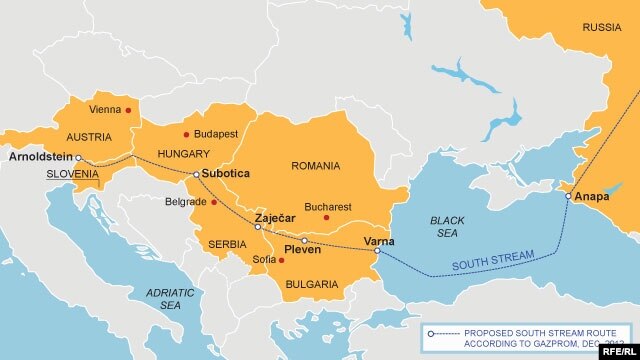
The proposed South Stream pipeline route, according to Gazprom
​​
Gazprom says South Stream will pass through Turkish waters to Bulgaria, then continue on through Serbia, Hungary, Slovenia, and Austria to tie in with the distribution network of the multinational Eni in northern Italy.

Officials in Brussels say they see South Stream's current status as moving from the "conceptual design and feasibility" stage to the "front-end engineering and design" phase.

In the latter phase, EU legislation requires numerous tasks that need approval from regulators in each country along the route and from the European Commission itself.

Russia says it has concluded intergovernmental agreements needed with each EU country involved, but the European Commission hasn't yet seen them all.

The deadline for EU states to submit those documents to Brussels is February 16, 2013. The commission then has nine months to assess the agreements and raise its doubts and concerns.

A detailed plan for the entire route must be submitted to Brussels, which also must approve environmental and social impact studies by national regulators in each EU country.

A "transboundary assessment" is also required, with input from EU states adjacent to the route. All studies require consultations with the public and authorities in each country and could take more than a year to complete.

Moreover, the offshore section of the pipeline entering Bulgaria must undergo an EU environmental-impact study to ensure it complies with environmental directives.

Russian-European Chamber of Commerce President Sergei Shuklin confirmed that the December 7 ceremony at Anapa will mostly be a ribbon-cutting affair without underwater construction activity.

"Yes, yeah, I agree with that. But it starts," Shuklin said. "Actually, by this action, Russia showed they are serious about this project. They are just going to make it happen. I'm pretty sure.... So they will have the first communications with the European Commission, with the governments of the countries participating in this project. So everything will be concluded [according to EU legislation], especially [since] Russia just became a member of the World Trade Organization."

So why did Gazprom rush to make its announcement?

Shuklin suggested it could be related to a probe launched in September by the European Commission into allegations that Gazprom engaged in anticompetitive practices in Central and Eastern Europe.


"Russia was actually surprised with the action related to Gazprom," he said. "And so probably, one of the reasons was, 'Yeah, let's just do it our way. We know people from the countries where we will build the pipe, and at this point, deal less with the European Union government.'"

Robert Cutler, a research fellow at Carleton University's Institute of European, Russian, and Eurasian Studies in Canada, maintains that Gazprom's push to announce the start of construction work on South Stream could also be related to domestic politics.

"On live Russian television, [President] Vladimir Putin gave [Prime Minister] Dmitry Medvedev a direct order: Construction of the pipeline should begin by the end of 2012," Cutler said. "There's a certain amount of prestige domestically invested now in producing some sort of result, even though physical construction of the pipeline probably was not in the cards then and certainly is not now.

"If Putin gives this order and Medvedev says, 'We'll do it,' but it doesn't end up happening, it raises questions domestically about their authority within the factions in the Kremlin and about Gazprom's credibility overall internationally."

According to Cutler, another reason is to give the appearance that South Stream is progressing faster than the Nabucco pipeline, a rival U.S.-backed project aimed at reducing Europe's dependence on Russian gas by linking the Caspian region and the Middle East to EU markets. 

10/20/2011

TYMOSHENKO, THE BIG BLUFF. (Tymoshenko, il grande bluff)

Far fuori gli avversari politici mettendoli dietro le sbarre non è certo il metodo migliore per gestire il potere ottenuto in maniera democratica. Eppure è quello che sta succedendo in Ucraina con il caso di Yulia Tymoshenko, ex primo ministro e leader dell’opposizione che è stata condannata a sette anni di galera per abuso di potere.

Al presidente Victor Yanukovich la dura sentenza serve anche per ottenere una piattaforma giuridica per tentare di ottenere la revisione dei contratti del 2009, obiettivamente svantaggiosi per il paese. Si spiega in questa maniera la reazione russa, con il Cremlino che sia durante il procedimento sia alla sua conclusione si è schierato a favore dell’imputata, sottolineando la validità degli accordi raggiunti tra l’eroina della rivoluzione arancione e Vladimir Putin due anni fa.
I rapporti tra Kiev e Mosca sono sempre passati attraverso le pipelines: è l’oro blu a unire o dividere, a seconda dei momenti. E i protagonisti di queste storie sono sempre gli stessi. In Ucraina Yulia Tymoshenko, ex principessa del gas che con il suo gruppo ha gestito per anni il traffico con la Russia e che prima è passata al ministero dell’Energia poi alla seggiola di premier; Dmitri Firtash, oligarca impegnato nell’energia e non solo, nemico giurato della bionda pasionaria; Yuri Boiko, attuale ministro dell’Energia, ex ceo a Naftogaz e uno dei suggeritori di Yanukovich, da anni schierato con l’ala conservatrice uscita dal blocco dell’ex presidente Leonid Kuchma cui appartengono gli altri magnati dell’industria ucraina, guidati da Rinat Akhmetov.

In Russia chi controlla Gazprom, cioè il Cremlino, è il vero gestore delle relazioni che toccano economia e politica: Putin impera. E se l’ormai scomparso Victor Chernomyrdin dopo essere stato per anni il numero uno di Gazprom era stato mandato a fare l’ambasciatore in Ucraina lo scorso decennio il motivo era chiaro. Politica e gas: gli intrecci al Cremlino sono come quelli alla Bankova e interpretarli non è sempre cosa semplice: ma è chiaro che il processo Tymoshenko si inserisce nel canovaccio dei duelli per il potere.
L’Europa in questa contesa fa da spettatrice: non ha danari per intraprendere un progetto consistente per la ristrutturazione del gas ucraino e rischia di lasciare via libera alla Russia che, avviato Nordstream, ha ora Southstream in progetto. Il sistema di trasporto ucraino va modernizzato e Gazprom vuole metterci sopra le mani, sul modello bielorusso (lo stesso dicasi per Naftogaz). Bruxelles si allarma per la Tymoshenko, ma non può permettersi di abbandonare i negoziati sull’accordo di associazione che dovrebbe essere firmato entro l’anno con Kiev.
L’errore europeo è stato quello di non capire che la rivoluzione del 2004 era un bluff. Gli ucraini l’anno capito da tempo, basta andare a guardarsi i sondaggi sul gradimento della Lady di ferro, peggiori di quelli di Yanukovich. Ora rischia di essere troppo tardi.
(Limes)

6/03/2011

RUSSIAN CUCUMBERS. (Cetrioli alla russa)

Dunque dopo la mucca pazza, la Sars, l’aviaria e la suina è arrivato il cetriolo killer. Le vittime causate da questa variante del batterio Escherichia Coli sono certamente tante, sempre troppe. Tuttavia, anche stavolta, il rischio è che a livello mediatico venga instillata la psicosi collettiva della pandemia. Insomma, abili operazioni di spin a vantaggio dei soliti noti, case farmaceutiche in testa.

Nel frattempo accadono due cose. Anzitutto i paesi europei si scannano come al solito tra loro, accusandosi l’un l’altro d’aver dato inizio al contagio. Zapatero ha già chiesto a Berlino un risarcimento di almeno 200 milioni di euro per il danno economico d’immagine provocato dalle insinuazioni tedesche. Dal canto suo la Russia, e questo è il secondo aspetto rilevante, ha pensato bene di chiudere temporaneamente le proprie frontiere agli ortaggi comunitari. Proprio così, a tutti gli ortaggi, dal momento che non si è ancora sicuri dove risieda effettivamente questo batterio killer.

Ovviamente a Bruxelles si è gridato al sacrilegio. Frederic Vincent, portavoce del commissario alla salute dell'Unione Europea s’è affrettato a definirla una “misura sproporzionata”. Proporzionatissimo era invece il blocco alle importazioni di pollame proveniente dalla Russia deciso dalla Commissione Europea ai tempi dell’aviaria. Due pesi e due misure. Ma si sa, noi europei abbiamo la memoria corta, anzi cortissima.

Il fatto è che sul piatto della contesa non ci sono solamente gli ortaggi. Anche per i poderosi stomaci russi i cetrioli possono essere particolarmente indigesti. Ma ancora più indigeste possono essere le liberalizzazioni energetiche, come quella contenuta nel “terzo pacchetto” Ue che prevede la separazione tra produzione e distribuzione. Unbundling è il termine tecnico.

Angry è invece stata la reazione di Putin al vertice energetico Russia-Ue dello scorso febbraio. Il terzo pacchetto è senza dubbio un pugno al ventre delle ambizioni di Mosca di tener ancorato a sé, per mezzo dei tubi, il Vecchio Continente. Per il momento inutili i tentativi del premier russo di far leva sugli accordi energetici siglati con i singoli stati dell’Unione, così come inutile è apparso il tentativo di convincere Barroso del rischio di un aumento dei prezzi affidando le reti di distribuzione a piccole compagnie alternative a Gazprom.

È noto che tra Putin e Barroso non scorra buon sangue. Alcuni file di Wikileaks non fanno che confermare quanto già risultava evidente ai tempi della crisi georgiana del 2008, quando il presidente della Commissione Europea minacciò di cessare l’acquisto europeo di gas russo se Mosca non avesse interrotto immediatamente le operazioni militari. Com’era prevedibile il messaggio entrò da un orecchio di Putin ed uscì subito dall’altro suo orecchio: in attesa dei gasdotti made in Usa che bypasserebbero il territorio della Federazione, per l’Ue il gas russo è semplicemente irrinunciabile.

Al contrario l’unbundling è per Putin una minaccia seria. Una misura che rischia veramente di allentare i cordoni di Mosca sull’Unione Europea. Un fattore di disturbo per la politica russa del “cortile di casa” est europeo.

Perciò Il blocco alle importazioni di ortaggi europei non può che essere interpretato anche come una ritorsione alle misure energetiche decise da Bruxelles. Una vendetta, che come si sa, è un piatto che va servito freddo. Senza l’ausilio di un fornello a gas.
Proprio come i cetrioli alla russa.

Ingredienti : cetrioli - sale - pepe - olio - aceto - prezzemolo - crema di latte.

Mondate i cetrioli e ritagliateli in fette finissime. Raccogliete queste fettine in una piccola insalatiera e cospargetele con un po' di sale fino, per privare il cetriolo della molta acqua di vegetazione che contiene.
Dopo una mezz'ora prendete un po' di fette alla volta, strizzatele e spandetele sopra un tovagliolo che poi arrotolerete pian piano.
Le fettine così rinchiuse si asciugano perfettamente.
Dopo un altro po' di tempo accomodate le fettine nei piattini da antipasto, conditele con pochissimo sale, pepe, olio, aceto e prezzemolo trito, aggiungendo una cucchiaiata o due di crema di latte sciolta.
Mettete i piattini preparati in frigo per almeno un'ora, affinché i cetrioli possano essere serviti freddissimi.
(Pubblicato su 24Emilia)

11/15/2010

BULGARIAN MAJORITY. (Maggioranza bulgara)

Russia and Bulgaria signed on Saturday accords to push ahead with the South Stream natural gas pipeline aimed to deliver gas to central and south Europe and cement Moscow's hold on European energy supplies.

Russian Prime Minister Vladimir Putin and his Bulgarian counterpart Boiko Borisov attended the signing of accords to set up a joint venture for the Bulgarian section of the project aimed at shipping Russian gas under the Black Sea to Europe.

'Today, a shareholder accord and a charter of the joint venture were signed. By doing this, we made one more serious step towards implementation of mutual agreements,' Putin told a news conference in Sofia where he arrived on a working visit.

The South Stream pipeline, controlled by Gazprom and Italy's ENI is planned to transport up to 63 billion cubic meters of gas to central and south Europe, bypassing countries such as Ukraine, at the end of 2015.

The link, in which French EDF is set to get a stake of no less than 10 percent, is a rival to the European Union-backed Nabucco pipeline, designed to bring gas from central Asia and the Middle East and reduce Europe's dependence on Russian deliveries.

Russia, the world's largest energy exporter, supplies Europe with a quarter of its gas needs. Analysts estimate European demand for Russian gas could rise to 30 percent by 2030.

Brussels and Moscow have been competing to sign up potential countries and suppliers for their projects.
The European Union member Bulgaria supports both projects, which are planned to run through its territory and has expressed concerns over delays in the Nabucco pipeline development.

'We are also working on the Nabucco pipeline with the same speed ... Bulgaria's interest is to transit gas through both pipelines,' Borisov told reporters.

His government, which put on review all Russian-backed energy projects last July, pledged to speed up work on South Stream after Gazprom promised to lower gas prices for Bulgaria, almost fully dependent on Russian gas supplies.

The Balkan country agreed to further accelerate work on the project in October, when Gazprom indicated South Stream could bypass it and run through Romania.

South Stream has also secured backing from Austria, Croatia, Greece, Hungary, Serbia and Slovenia.

Gazprom and state-controlled Bulgarian Energy Holding, which will have 50/50 stakes in the new venture, have already opened a tender to seek contractors for a feasibility study for the Bulgarian section, estimated to cost $835 million.

Bulgaria secures about 70 percent of its energy needs through imports. It gets almost all of its gas from Gazprom, its only nuclear power plant Kozloduy is Soviet-made and its only operational oil refinery is owned by Russia's LUKOIL.

Putin said LUKOIL was set to invest up to $2 billion more in its Bourgas-based oil refinery, Lukoil Neftochim.
Bulgaria and Russia also discussed the Belene nuclear power plant project, which Sofia had also put on hold due to a lack of funding and strategic partners.

Sofia has said it will push ahead with the 2,000 megawatt plant, for which it has contracted Russia's state Atomstroyexport, only if backed by strategic European investors.

Borisov has indicated Bulgaria is close to finding a partner in Germany for Belene, estimated to cost over 7 billion euros.

Bulgaria's warming towards the projects has irked Washington and Brussels which are encouraging Bulgaria to lessen its heavy energy dependence on Russia.

Belene froze last November, when German energy giant RWE , which had agreed on a 49 percent stake, pulled out.

Sofia wants to build Belene so as not to lose hundreds of millions of euros it has already invested and to avoid paying hefty compensation to the Russian contractor, Atomstroyexport.
(XE, via Reuters)

10/14/2010

ALL AT THE ZAR COURT. (Tutti alla corte dello zar)

Alcune compagnie energetiche tedesche hanno espresso il desiderio di partecipare al progetto South Stream. E’ quanto emerge dall’incontro Berlusconi-Putin di domenica scorsa. Ecco che le ali del Nabucco sono sempre meno dorate e, se le cose continueranno per questa china, il progetto energetico europeo non andrà lontano. Nabucco è infatti il nome dato al gasdotto che dal mar Caspio dovrebbe rifornire i Balcani fino all’Italia e all’Austria. Lo scopo della sua costruzione è eminentemente geopolitico: estendere l’influenza “occidentale” sui Balcani e sul Caucaso. La sua progettazione è precedente all’adesione all’Unione Europea dei Balcani orientali e si profila quale strumento di persuasione a restare in orbita europea per i Paesi che vedono procedere a rilento il loro percorso di integrazione. Nabucco nasce come concorrente del South Stream russo poiché, si ragionò giustamente, dipendere dalla Russia nel settore dei rifornimenti energetici significherebbe perdere larghe fette di sovranità: come criticare la diplomazia di Mosca nel campo dei diritti umani se dal Cremlino controllano i rubinetti del gas? Come osteggiare la politica estera di Mosca, le guerre in Cecenia e in Georgia, l’assalto all’Artico, le ingerenze in Ucraina, se si diventa servi del gas russo? E ancora: come affermare l’autonomia dell’Unione di fronte a un duplice vassallaggio, militare-americano da un lato e russo-energetico dall’altro?
Ma sul Nabucco si è investito poco e male. L’Italia e l’Eni sono state le prime a capire che non c’era di che ingrassarsi col progetto europeo e si son subito vendute al “rivale” russo. Eni e Gazprom diventano così partners per la costruzione del South Stream con tanti saluti all’europeo Nabucco. L’Italia, che con difficoltà si annovera tra le democrazie compiute, predilige fare affari con Putin e Gheddafi. La torta russa piace non solo agli italiani, ecco che la Edf (Electricité de France) entra nella joint-venture con Gazprom ed Eni. Lo scorso giugno 2010 Nicolas Sarkozy vola a San Pietroburgo alla corte dello zar per sottoscrivere l’affare.

Ora anche i tedeschi vogliono partecipare all’abbuffata. “Benone” esclama Berlusconi in visita presso l’amico Putin, in questo modo sarà possibile riscuotere l’interesse dell’Unione Europea finora rimasta fredda nei confronti del South Stream. I tedeschi, va detto, già sono partner di Gazprom per la costruzione del gasdotto North Stream, quello che aggira repubbliche baltiche e Polonia (ree di scarso amore verso lo zar) e va dritto in Germania; quello sottoscritto a inizio anni Duemila dall’allora cancelliere Schroeder, attratto dall’oro azzurro russo, poi divenuto dirigente Gazprom e responsabile proprio del consorzio North Stream; quello per cui in Polonia si stracciano le vesti gridando a un nuovo patto Molotov-Ribbentrop.

Rumors indicano nella Basf il nome dell’azienda energetica tedesca pronta a unirsi ai tre moschettieri Gazprom, Eni, Edf. Un’ulteriore mazzata al progetto Nabucco per il quale la Banca europea per gli Investimenti (Bei) e quella per la Ricostruzione e Sviluppo (Bers) hanno appena stanziato altri 4 miliardi di euro, segno che l’affrancamento energetico dell’Europa dalla Russia è considerato prioritario da Bruxelles che si trova a dover gestire tre serpi in seno assai velenose.

Una nota finale: il Nabucco parte dall’Iran, via Tabriz ed Erzurum. Proprio ad Erzurum raccoglie il braccio che s’avvia da Baku e passa per Tiblisi. Poi va verso Ankara, Istanbul e l’Europa. Il governo italiano si è sempre mostrato molto duro nei confronti del regime degli Ayatollah, ai limiti dell’ottusità, e si è detto favorevole all’intervento militare a stelle e strisce mentre, per ragioni che dopo questo lungo discorso parranno ovvie, non ha mai detto “beh” sul massacro in Cecenia.

I partners del Nabucco, inoltre, stanno tutti cambiando casacca: L’Azerbaijan si è vincolato con Mosca, e ben poco della sua produzione resterà a Bruxelles, ma il Cremlino ha promesso protezione e denari in quantità al regime di Baku. Il Turkmenistan, altra dittatura, è da pochissimo entrata in affari con Eni e Gazprom e punta a rifornire la Cina più che l’Europa.
L’Iran -grazie anche all’intervento americano- è assai indietro nello sviluppo dei suoi giacimenti. Ecco allora che non resta che prendersi in faccia l’ironia di Putin: “Che Dio li aiuti -ha dichiarato- il Nabucco è un tubo vuoto e il consorzio che lo sta sviluppando (l’austriaca Omw, l’ungherese Mol, la rumena Transgaz, la Bulgargas, la tedesca Rwe e la turca Botas. ndr) non fornirà nemmeno un metro cubo di gas fino al 2018 mentre fra un anno il South Stream sarà pronto”. Con buona pace della democrazia europea.
(East Journal)

5/06/2010

10 ME, 10 YOU (10 io, 10 te)

Russian and Italy will each give a 10% stake in the South Stream pipeline to France's EDF , Russian Prime Minister Vladimir Putin said today.

"We will do it concurrently - us and the Italians, 10% each," Putin told reporters on a visit to Ukraine which followed a meeting with Italian Prime Minister Silvio Berlusconi in Italy.

EDF is set to get a 20% stake in the South Stream gas pipeline designed to bring Russian gas to Europe, with work on the project due to start in the first half of 2012, Putin and Berlusconi said today.

Separately, Putin said Russia's budget will lose $3 billion this year and $4 billion in 2011 as a result of agreeing last week to a 30% cut in the price of its gas supplies to Ukraine.

"In essence it will mean an increase in the budget deficit for us," he said. "These are serious parameters, but we will manage."

Russia had expected a deficit of 3 trillion roubles ($103 billion), or 6.8% of gross domestic product this year, Reuters reported today.
(UpStreamOnline.com)

4/23/2010

SEVASTOPOL PAID IN GAS? (Sevastopoli pagata in metano?)

The presidents of Ukraine and Russia agreed Wednesday to extend the stay of Russia's Black Sea Fleet in the Ukrainian port of Sevastopol after the lease expires in 2017.

The move is among the strongest signs since Ukrainian President Viktor Yanukovych took power in February that he will steer away from his pro-Western predecessor's drive to shed Russia's influence.

It also is likely to boost Yanukovych's standing at home by taking some pressure off Ukraine's beleaguered economy. The agreement includes Russia giving Ukraine steep discounts for the natural gas on which its industries depend.

Ukraine has been hit harder by the global downturn than many other European countries, and it has been eager to get discounts for Russian gas.

For years, Ukraine bought Russian gas at well below market prices, but after Yushchenko took office and pledged to bring the country into NATO and the European Union, Russia repeatedly raised prices. Price disputes led to Russian gas cutoffs; the most severe, in early 2009, lasted two weeks and severely curtailed Russia's gas exports to Western Europe, most of which transit Ukraine.

Russian President Dmitry Medvedev said the base's lease would receive a 25-year extension. Russia pays $90 million per year for the base. There was no word on any change under the new deal.

Ukrainian opposition figures quickly criticized the deal, saying the lease extension violated the constitution.

Ukraine's previous president, Viktor Yushchenko, had fought to kick the fleet out when its lease expired, calling it a hostile presence in Ukraine.
(Dallas News)

---------------------------------------------------------------------------------

The smiles on the two president’s faces belied the hard work that had gone into making the deal happen. According to the Kommersant daily the negotiating teams, headed by Prime Ministers Vladimir Putin and Nikolai Azarov, and including on the Russian side Foreign Minister Sergei Lavrov and Defense Minister Anatoly Serdyukov, had been up all night finalizing the details of the agreement. Russian President Dmitry Medvedev and Ukrainian President Viktor Yanukovich were just going through the formalities.

But there is a good reason for the smiles and the attention to detail. The deal addresses three of the most sensitive issues in Russian-Ukrainian relations: the future of the Russian Baltic Fleet, gas supplies, and potential Ukrainian membership in NATO.

The Black Sea fleet will get to stay in Sevastopol, its historic and only really viable base, until 2042; that saves Russia money on building new naval facilities on its own Black Sea coast, but it also gives it a “political-strategic” victory, said Volodymyr Fesenko, the head of the Penta Center for Applied Political Studies in Kiev. “Russia not only preserves a military presence in the Black Sea basin and on Ukrainian territory, but also has a factor of influence on external security policy and internal affairs in Ukraine,” he said.

According to some commentators, including the Kommersant daily, the jewel in the crown of that influence is that since NATO membership rules forbid the presence of non-alliance military bases on members’ territory, the agreement effectively puts a 30-year freeze on Ukraine’s aspirations to join the North Atlantic Alliance. NATO membership was a key policy of Yanukovich’s predecessor, former President Vitor Yushchenko, and the source of much of the ill feeling between his administration and Moscow.

The quid-pro-quo is a 30 percent discount on Russian gas deliveries, which, according to the deal, Ukraine will count as additional rent payments on the Sevastopol port. For Ukraine, that basically means a saving of $100 per 1,000 cubic meters of gas (for the record, the discount will be $100 per 1,000 cubic meters when prices are over $330, and 30 percent for lower prices. Current prices are around $334. The discount will apply to 30 billion cubic meters in 2010, and 40 billion from 2011 onwards).

At yesterday’s press conference Yanukovich said that Ukraine would receive from Russia “a real investment of resources, specifically gas,” amounting to “around $40 billion dollars” over the next ten years. “And this bears the hallmarks of an economic victory for Ukraine,” said Fesenko.

It’s so far difficult to tell whether an economic win for Ukraine means a loss for Russia. In a note released Thursday morning Alfa Bank briefly pointed out that the gas discount would come at the expense of the Russian government, rather than Gazprom, but a spokesman for the bank refused to comment further, saying that the company’s Kiev and Moscow analysts were still working out the long-term implications.

Sergei Markov, a political scientist and State Duma Deputy for the United Russia faction, insisted the $40 billion cited by Yanukovich in yesterday’s press conference was an investment on which Russia expects a return. “Russia is likely to get a lot of profit from joint Russian-Ukrainian economic projects,” he said. “It’s a popular but crude mistake to suppose that Russia is paying for the Black Sea Fleet with gas.” (Markov also contests the widely held assumption that the deal will preclude NATO membership, pointing out that when the George W. Bush administration was cheerleading Yushchenko’s membership bid, U.S. officials had said the Russian base ought not to be a barrier).

According to Markov, the deal around the Black Sea Fleet is actually much simpler. “Russia saves hundreds of millions of dollars that it would otherwise have to spend building new naval bases in Novorossiysk and elsewhere,” he said. “The deal is, Ukraine lets us stay in Sevastopol, and we share the savings.”

Not everyone is so convinced by either the supposed Chinese wall between the two agreements, or the benefits of the deal. Russian opposition leader and one-time advisor to former Ukrainian president Yushchenko Boris Nemtsov told the Kommersant daily that “we could have demanded more for that money,” and warned darkly of the “Lukashenko factor,” – a reference to Belarusian President Alexander Lukashenko, who has gained a reputation for taking Russian aid without reciprocation. (Others have also raised the Lukashenko parallel, but not always negatively. Victor Ozerov, the chairman of the Federation Council’s defense committee, told Kommersant that though the price was high, it was no less than Russia grants Belarus, “and Lukashenko threatens worse relations.” And Markov even suggested that improved relations with Kiev might strengthen Moscow’s hand in its troubled relations with Minsk).

Meanwhile, in Ukraine, the deal is proving even more divisive. The presence of the Black Sea Fleet in Sevastopol is a subject that polarizes Ukrainian society, and it has unified the fractious opposition for the first time since the presidential elections, said Fesenko. “Two days ago Yushchenko, [former Prime Minister Yulia] Tymoshenko, [Arseniy] Yatsenyuk, [Vyacheslav] Kiriyenko, were all criticizing each other. Now they’re united in criticizing the agreement about the Black Sea Fleet,” he said. On Thursday afternoon it was reported that the Ukrainian Constitutional Court had approved the deal, but that doesn’t mean it will pass into law. “In the coming days we may see a parliamentary crisis as the opposition attempts to block ratification of the deal,” said Fesenko.
(Russia Profile)

4/12/2010

NORD STREAM TIME. (L'ora del Nord Stream)

Construction of the controversial Nord Stream pipeline from Russia to western Europe under the Baltic Sea has been officially launched.

Gazprom holds 51% of Nord Stream, which will run from the Russian port of Vyborg to Germany's Greifswald.

Russian President Dmitry Medvedev and German Chancellor Angela Merkel attended the ceremony near Vyborg.

The project was given the go-ahead only in February amid fears that the pipeline could damage the Baltic Sea.

President Medvedev said at the ceremony that the pipeline "for the first time - which may be one of its main achievements - will ensure direct supplies of Russian gas to western Europe, bypassing transit territories".

The existing pipelines run from Russia to EU countries via Ukraine, Belarus and Moldova.

Russia provides up to 30% of the gas consumed in Europe, and many European countries have been keen to secure alternative energy supplies.

Critics have argued that European countries do not need more gas from Russia and that the project is too expensive.

But Gazprom deputy chief executive Alexander Medvedev said there was plenty of demand for the gas.

"All the gas volumes have either been contracted, or have been formalized in binding obligations," he told journalists.

Gas supplies from Russia to Europe have been threatened or disrupted in the past due to political and financial disputes between Moscow and its neighbours.

But Russian President Dmitry Medvedev said at the ceremony: "This country [Russia] has been cooperating with European neighbours in the gas sector for over 40 years.

"This cooperation has stood the test of time to the full extent."

The ceremony was also attended by Nord Stream board chairman and former German Chancellor Gerhard Schroeder, Dutch Prime Minister Jan Peter Balkenende and European Commissioner for Energy
Russian gas monopoly Gazprom said on Wednesday that the first pipe had been laid under the sea.

The pipeline will be passing through Russian, Finnish, Swedish and German waters.

Last month, Nord Stream secured a 3.9bn-euro ($5.4bn; £3.5bn) fund to complete the first phase of the pipeline.

"Debt financing will cover 70% of the project costs while the remaining 30% will be provided by the project shareholders," said Paul Corcoran, financial director of Nord Stream AG.

German companies BASF-Wintershall and E.On Ruhrgas each own 20% of Nord Stream, while Gasunie of the Netherlands holds 9%.

Alexey Bulgakov from Troika Dialog investment bank pointed out that "Gazprom and its partners seem to have managed to raise funds at rather low interest rates."

The overall cost of the project, due for completion in 2012, is expected to reach 7.4bn euros.

Russia hopes to pump up to 55bn cubic metres of gas a year to EU countries through the pipeline.
Supporters of the project say that it will secure gas supplies from Russia to Europe.
But environmentalists argue that building the pipeline could lead to toxins lying on the sea bed being stirred up, as the Baltic sea is one of the most polluted in the world.

Finland had refused to give the green light to construct the pipeline, but finally agreed to it in February under the condition that ships laying the pipeline do not lay anchor in Finland's economic zone.

The final hurdle was overcome after Russian Prime Minister Vladimir Putin assured Baltic leaders that the project was safe, as extensive research had been carried out into any environmental impact of the pipeline construction.

Apart from the Nord Stream, Russia has been planning another pipeline, the South Stream, which will run from southern Russia to Bulgaria under the Black Sea.

Meanwhile, Turkey, Romania, Bulgaria, Hungary and Austria last July signed an agreement to construct the long-planned 3,300km Nabucco natural gas pipeline.

It is expected to pump up to 31bn cubic metres of gas annually from the Caspian and the Middle East across Turkey and into Europe.
(BBC)

3/10/2010

WELCOME TO SHTOKMAN. (Benvenuti a Shtokman)


Background information


The Shtokman gas and condensate field - one of the biggest offshore fields of its kind - was discovered in 1988. The field is located in the central part of the Russian sector of the Barents Sea shelf, about 600 km northeast of the city of Murmansk at sea depths varying from 320 to 340 m.

The field’s C1+C2 reserves account for 3.8 tcm of gas and circa 37 mln t of gas condensate.

The Sevmorneftegaz - a 100 percent Gazprom subsidiary - holds the license to the project. The operator company is the Shtokman Development Company, a Swiss-registered joint venture of Gazprom (51%), Total (25%) and StatoilHydro (24%).

The Shtokman gas will be shipped partly by pipeline, partly as LNG.

According to plans, the field is to be in production from year 2013.

The village of Teriberka located northeast of Murmansk City has been chosen as the main hub for Shtokman operations.
(Barents Observer)


Shtokman postponed 3 years

The Shtokman Development AG's board of directors today decided to postpone the development of the huge field in the Barents Sea with three years.

A press release from the company confirms that a final investment decision in the project's pipeline part will be taken in March 2011, while the decision on the LNG part will be taken before the end of 2011, newspaper Vedomosti reports.

About 50 percent of the 3,8 trillion cubic meter of Shtokman gas is planned developed as LNG, the remaining shipped through pipelines. The Shtokman field, located offshore about 600 km north of Murmansk, has long been a top priority project of Gazprom. It is to be developed by the Shtokman Development AG, a company controled by Gazprom (51%) in partnership with Total (25%) and Statoil (24%).

Both the Shtokman Development AG and Gazprom has long stressed that the project will be in operation from year 2013 (the pipeline part) and 2014 (the LNG part).

As BarentsObserver has reported, several experts have recently claimed that the huge Arctic project will face serious delays, and that it might even never be developed. Among them is Oddgeir Danielsen from the Norwegian Barents Secretariat. Now, the project will not be in production before 2016, at earliest.
(Barents Observer)


Disputed waters on the agenda

Just few weeks before Russian President Dmitry Medvedev arrives in Oslo for a state visit, both Norwegian Prime Minister Jens Stoltenberg and Russia’s Vladimir Putin highlight the positive dynamics in talks over the disputed waters in the Barents Sea.

In their meeting in Helsinki yesterday, Stoltenberg and Putin confirmed the “good and productive atmosphere” in the talks over the delimitation of the Barents Sea. Both men agreed that a deal would significantly facilitate new joint projects in the two countries’ High North.

-I believe that if we manage to solve this issue, new fields of opportunities for extended economic cooperation will open, among them in the energy sector, Stoltenberg said in a press conference following the meeting, the Russian Government press service informs.

The meeting, which was held during the Baltic Sea Action Summit, lasted for about 45 minutes, and both the Shtokman field and the disputed zone were on the agenda. Both issues are highly inter-related. The huge Shtokman field is located not far from the disputed 155,000 square km zone, and is by the Norwegian side seen as a strategically key project.

In addition, the zone is believed to hide significant hydrocarbon resources. A deal on the zone delimitation and subsequent oil and gas developments in the area would have major possible impact on the Shtokman field development.

In a time with uncertainties in the world gas market, the opening of the disputed waters for oil and gas activities, would make the development of the Shtokman field more attractive. The Shtokman developers Gazprom, Total and Statoil would then not only be able to use field infrastructure in additional projects, but also have a significant chance to succeed in bids for other fields in the area.

Talking to newspaper Aftenposten after the meeting in Helsinki, Prime Minister Stoltenberg underlined that hydrocarbon developments in the Disputed Zone are impossible as long as there is no delimitation deal. He also highlighted that the oil and gas resources in the zone are located far closer to land than the Shtokman field and that they would therefore also be far easier to develop.

Talks between Norway and Russian on the delimitation of the 155,000 square kilometer zone in the Barents Sea have been going on for almost 40 years. While Norway wants to divide the zone based on a middle line principle, Russia insists that a sector line principle is applie
(Barents Observer)


Gazprom discussed Shtokman timeline

The development of the first development phase of the Shtokman project was on the agenda when Gazprom Deputy Aleksandr Ananenkov today met with owner representatives of the Shtokman Development AG.

The meeting, which took place in the Moscow headquarters of Gazprom, discussed preparations for the development of the project, and especially issues related to time schedules in the project’s first development phase, a press release from the company reads.

The company in early February announced that the project launch will be postponed from 2014 to 2016 and that a final investment decision will be made only in 2011, and not in 2010 as earlier planned.

However, as reported by BarentsObserver this week, representatives of project partner Total maintain that the project is on schedule after all. That was also stated earlier by Gazprom Deputy Aleksandr Medvedev
(Barents Observer)

1/10/2010

GO EAST(WARDS)!

Russia expanded its foothold on the Asian energy market with the click of a mouse Monday [28th December].

Prime Minister Vladimir Putin pressed a button to get Siberian oil flowing into the first tanker for delivery to an Asian customer, in Hong Kong, from Russia’s Pacific coast. In addition to China, supplies will also target Japan and South Korea.

The ceremony completed four years of work to construct the East Siberia-Pacific Ocean pipeline and the Kozmino port, worth a combined 420 billion rubles ($14 billion) to ease the industry’s reliance on the European market.

“It’s a strategic project because it allows us to enter the completely new, growing and promising markets of the Asian-Pacific region,” Putin said at the launch. “It’s a great present to Russia for the New Year.”

The foray into the Asian oil market follows Russia’s arrival as a major supplier of liquefied natural gas, or LNG, for its eastern neighbors earlier this year. The Gazprom-led Sakhalin-2 project — with Shell, Mitsui and Mitsubishi as partners — started shipping the gas, chilled to a liquid for loading into tankers, from Russia’s offshore fields in the Pacific in February.

As it expands into new markets, Russia is keeping abreast of the global trend of diversification among both energy buyers and sellers, which will make the business more competitive worldwide, said Elena Shadrina, a visiting energy researcher at the Norwegian Institute for Defense Studies.

“No supplier or consumer will have a dominant position,” she said by telephone from Oslo.

Europe is trying to offset its dependence on gas imports from Russia by looking to buy more from Africa, while Turkmenistan began exporting its gas to China earlier this month, ending Russia’s role as its only major buyer. Asia, in turn, has been seeking alternatives to supplies from the Middle East.

Russia’s progress in eastward expansion has been spectacular, defying doubts that the country has sufficient oil reserves and investment, Shadrina said.

“As little as five years ago, I heard skeptical attitudes from Japanese officials and analysts,” she said. “The tone has really changed now.”

The Kozmino port, near Vladivostok, cost $2 billion to build and has the capacity to handle 300,000 barrels of crude per day (15 million tons per year), with oil quality comparable to that of Middle Eastern blends now dominating the market.

Transneft, the state pipeline monopoly, spent another $12 billion to lay the 2,694-kilometer ESPO pipeline through east Siberian wilderness to connect the area’s greenfields, being developed by oil majors Rosneft, TNK-BP and Surgutneftegaz, to the railway station of Skovorodino. The link has the capacity to carry 30 million tons a year.

Arriving in Skovorodino, the crude is loaded onto trains to travel to the port by rail.

Transneft plans to start building the rest of the pipeline to Kozmino, which requires an estimated investment of $10 billion, next year and complete the work in 2014. The effort will bring the link’s total length to 4,794 kilometers, which is more than the distance from New York to Los Angeles.

When completed, the pipeline will carry eastward an annual 80 million tons of oil from Siberia, including 15 million tons to China through an additional spur. China has loaned $25 billion to Russia in exchange for oil deliveries over the next two decades. Kozmino will increase capacity to 600,000 barrels per day, or 30 million tons per year.

Seeking the huge investment for the remote east Siberian greenfields that are to feed the pipeline, Russia will likely ease access to these resources by foreign oil majors, said Shamil Yenikeyeff, a researcher at the Oxford Institute for Energy Studies. A law enacted last year allows the government to take away a field from a foreign company if it strikes large oil reserves there during exploration, a restriction that put off potential investors, such as Royal Dutch Shell.

Yenikeyeff said Russia’s emergence this year as an Asian energy power — while being a wise policy — displayed the country’s continuing reliance on oil and gas exports for economic prosperity.
“You may call this a new era,” he said, referring to the unlocking of new markets. “The question is: Does this mean that Russia will grow even more affected by the oil curse? If you look at the other industries, nothing is happening there.”

The first tanker’s crude that left Kozmino belongs to state-controlled Rosneft and represents a new oil blend named ESPO, after the pipeline. The low-sulphur, medium-heavy sweet blend ranks higher than Russia’s main export blend, Urals, but its quality is going to be unstable for a while as more producers pump their oil in the pipeline.

The price of the crude is tentatively based on the average monthly price of the Middle Eastern benchmark Dubai blend, with the option for traders to offer a discount or premium. Rosneft sold the first shipment to the Finnish trader IPP Oy at a premium of 50 cents.
(The Moscow Times)

10/26/2009

BERLUSCONI'S MOST IMPORTANT FLIRT (Il flirt più importante di Berlusconi)

Silvio Berlusconi and Vladimir Putin, meeting in St Petersburg, have given new impetus to the race to supply gas to Europe. The Italian prime minister is joining his Russian counterpart in pushing the South Stream project over another pipeline backed by the EU. The announcement followed discussions by video phone with Turkey’s Prime Minister Recep Tayyip Erdogan.

South Stream, said Putin, had to be constructed quicker than North Stream, a third pipeline that will run under the Baltic Sea and then pass through Scandinavia. The Russian premier said it was possible because the three countries already had experience working together on another building project on Turkish soil, the Blue Stream construction.


South Stream is a joint project involving Russia’s Gazprom and Italy’s ENI. After running under the Black Sea, two possible routes are being studied to supply gas to western Europe.
The agreement was sealed back in August during a one-day visit by Vladimir Putin to Ankara. The Turkish prime minister said he saw South Stream as a parallel rather than a rival project to the EU-backed Nabucco pipeline – as both would be needed in the future.


---------------------------------------------------------------------------------


The three leaders had a comprehensive talk concerning the South Stream pipeline project, which is to be constructed jointly by Russia’s Gazprom and Italy’s Eni. Putin remarked that issues with Turkey had been resolved, referring to the announcement earlier this week of Turkey’s decision to allow geological exploration in its Black Sea economic zone as part of the South Stream project.


Berlusconi, who is currently in Russia, mentioned on Wednesday the cooperation between Turkey and Italy in the field of technology and the helicopter manufacturing plant that is being established in Turkey through an equal partnership between Italy’s Agusta and a Turkish company. Italy is ready to establish similar partnerships with Russia, too, he added. Berlusconi had also attended talks during Putin’s visit to Ankara on Aug. 6.


PM Erdoğan held a teleconference with Russian and Italian prime ministers on energy issues.
Earlier this week, Turkey, Russia and Italy signed a memorandum of understanding on the Samsun-Ceyhan oil pipeline in Milan. The project will be carried out by the Trans-Anatolian Pipeline Company (TAPCO) in which Italian energy company Eni and Turkish company Çalık Energy each hold a 50 percent stake.


The South Stream project is set to eventually run from Russia to Bulgaria under the Black Sea before delivering gas to consumers in Europe. The pipeline, with an annual capacity of 63 billion cubic meters, is planned to be operational in 2016, costing $11.6 billion.

8/08/2009

RUSSIAN-TURKISH BARGAINING CHIPS (Merce di scambio russo-turca)

Russian Prime Minister Vladimir Putin's August 6 visit to Ankara marked a new era for "enhanced multi-dimensional partnership," between Ankara and Moscow. Putin and Recep Tayyip Erdogan signed some twenty agreements covering energy, trade and other fields. Italian Prime Minister Silvio Berlusconi also attended part of the talks between Erdogan and Putin, considering the involvement of Italian companies in some of these projects. The most remarkable dimension of the various joint projects concerns energy cooperation, most notably Turkey's expression of support for Russia's South Stream project.

In oil transportation, Russia committed to participate in the planned Samsun-Ceyhan pipeline (SCP), connecting the Turkish Black Sea city of Samsun to the Mediterranean terminal Ceyhan. Turkey has solicited Russian participation in the SCP, which will bypass the congested Turkish Straits. Moscow has proven reluctant, and has instead promoted another bypass option through Burgas-Alexandroupolis between Bulgaria and Greece. Meanwhile, Turkey took further steps to make the SCP attractive for the Russian side, by linking this project with the Turkish-Israeli-Indian energy partnership.

Erdogan expressed his pleasure with the Russian decision to commit its crude. Ankara can consider this development as its greatest success in this grand bargain, given that Turkey has worked to convert Ceyhan, where the Baku-Tbilisi-Ceyhan pipeline also terminates, into a global energy hub. However, Putin did not rule out interest in Burgas-Alexandroupolis, and instead emphasized that the two pipelines might be complementary in meeting the growing demand for export routes. This statement raises questions about how committed Russia will be to the SCP, given that Russian companies own the majority of shares in the other Burgas-Alexandroupolis option.

In terms of gas cooperation, Turkey will allow Russia to conduct explorations and feasibility studies in the Turkish exclusive economic zone in the Black Sea, as part of Russian plans to construct South Stream. Since this move comes against the background of Turkey's decision to sign the rival Nabucco pipeline agreement last month, it raises many questions, as to how it will affect Nabucco, which Turkey considers a "strategic priority," as well as European energy security issues. Despite the questions surrounding its feasibility and high costs, as well as its negative implications for Nabucco, Erdogan maintained that both projects contribute to diversification efforts.

It appears that the "grand bargain" was between the SCP and Blue Stream. Ahead of the meeting, Yuri Ushakov, the Deputy Head of the Russian Government Staff said that "Turkey made concessions in South Stream and we made concessions in SCP," but added that he had doubts over the SCP's feasibility. A statement from Berlusconi's office also claimed that he had helped broker a rapprochement between both countries on these two issues. However, domestically, there are concerns that in this "exchange" of concessions, Turkey did not gain much. The SCP's importance was inflated, because it was developed by business interests close to the government. Another gas deal concerned Ankara's request to renew the contract under which it purchases Russian gas through the Western pipeline via the Balkans. Erdogan announced that the contract (which expires in 2011) will be renewed for 20 years. Turkey had complained about the high prices and the leave-or-pay conditions in its gas deals with Russia. Putin said it was renewed on favorable terms to Turkey, but the contract's details are unclear.

Erdogan also said that they discussed the extension of Blue Stream II to transport Russian gas to Israel, Lebanon and even Cyprus. Blue Stream, running underneath the Black Sea, is the second route carrying Russian gas to Turkey. Moscow previously raised the possibility that it could use Blue Stream II in order to transport gas to Europe, but this option was rejected, since it contradicted Nabucco and Russia sought to use Turkey only as a transportation route. Now, Ankara wants to revive it as part of a North-South corridor. Based on the leaders' statements, it appears that the existing capacity of Blue Stream might be improved and gas could be transferred to the Mediterranean through this pipeline.

However, although Erdogan praised this development as another major success, there is no guarantee that Russia will grant "re-export rights," which indicates that if Blue Stream II is implemented, Moscow will continue to view Turkish territory as a mere conduit for its gas, which raises the question: how will Turkey benefit from the agreement? Russian priorities also involve Turkey's first nuclear power plant tender, which was awarded to a Russian-Turkish consortium. As the original price was too high, the tender has long awaited cabinet approval. Meanwhile, the Russian side lowered the price, and offered a compromise. Prior to Putin's visit, it was expected that with further "bargaining," a final deal might be reached, but apparently it failed. Nevertheless, Ankara and Moscow signed protocols regarding energy cooperation, including the use of nuclear energy for peaceful purposes, early notification of accidents, exchange of information on facilities, and to continue talks on the nuclear tender.

The most controversial development is perhaps Ankara's support for South Stream. Erdogan reiterated his belief that Nabucco and South Stream are complementary, yet turned a blind eye to several Russian officials' (including Putin) statements to the contrary. It is assumed in Ankara that growing European energy demand will accommodate both projects; but this ignores the competition between both projects over the same downstream markets. Moreover, the Turkish side fails to appreciate the challenges Russia is facing in investing in its domestic gas industry, and acts on the assumption that "Russia has enormous reserves," while failing to realize that Russia is also planning to tap into the same upstream producers, namely Central Asian and Caspian gas, just as the Nabucco project envisages.

Putin also added that a consensus was reached on Russia building gas storage facilities in the Salt Lake. Taken together with the announced joint investments between Turkish and Russian firms, including Gazprom, it is unclear whether the Turkish government recognizes the consequences of these decisions. Russia has effectively used the practice of co-opting the gas infrastructure of transport and consumer countries, as part of its efforts to monopolize downstream markets. It is unclear how this penetration into the Turkish grid might affect Ankara's future energy policies.
(Jamestown)