Visualizzazione post con etichetta Kazakhstan. Mostra tutti i post

12/20/2011

KAZAKH OIL WORKERS PROTEST.(Gli operai del settore petrolifero kazako protestano)

Holding signs with the slogan, “Don’t Shoot the People,” hundreds of oil workers in the city of Aktau in western Kazakhstan protested today against a recent police crackdown on striking workers, the New York Times reported. Clashes with police on Dec. 16 and Dec. 17 caused the deaths of at least 14 striking workers and wounded dozens more.
Thousands of oilmen had been on strike in the Mangistau region since May, demanding wage increases, Reuters reported. On Friday in the city of Zhanaozen, police fired on protesters in the central square, killing at least 13, the New York Times reported.

According to the New York Times:
The workers in Zhanaozen appear to have grown angry when officials began installing holiday decorations for a government-sponsored children’s party, which they felt was a ruse to remove them from the square, witnesses said. Officials said the police were forced to open fire after they came under attack by “hooligans,” some armed with stones and gasoline bombs.

Interior Minister Kalmukhambet Kasymov said the police had no choice but to fire their weapons, The Associated Press reported. “Nobody specifically gave the order to open fire in that situation,” he told the AP. “Every police officer took the decision themselves. When they take a weapon off you, there is no need for an order to be issued.”

After the clash in the square, Kasymov said, the crowd raged throughout the city, setting fire to the mayor’s office, a hotel, the UzenMunaiGas oil company headquarters and the local branch of the governing Nur Otan party.

On Saturday, one person was killed when police fired on several hundred protesters who blocked railroad tracks in the nearby city of Shetpe, the New York Times reported.

The Organization for Security and Cooperation in Europe chairperson-in-office, Lithuanian Foreign Minister Audronius Azubalis, expressed dismay at the way the situation was handled, the AP reported. “Any action to control crowds by law enforcement should be proportionate and in line with international human rights standards,” he said in a statement.
On Dec. 17, Kazakhstan’s President Nursultan Nazarbayev declared a three-week state of emergency for Zhanaozen, the AP reported.
(GlobalPost)

Qui il link al sito dei manifestanti Campaign Kazakhstan.

12/01/2009

MULTI-VECTOR ENERGY POLICY. (Una politica energetica multivettoriale)

Kazakhstan wants to leave politics out of the equation and make a profit when dealing with the transport of hydrocarbons, the country’s foreign minister told five visiting western journalists at his lavish ministry in Astana.

“The fundamental principle from which we are proceeding on exporting our resources is the principle of economic feasibility - no politics there.

We have exported and will be exporting in any direction that is profitable for us,” Kanat Saudabayev said on 23 November. He was responding to a question from New Europe on whether the energy-rich former Soviet republic had any preference over Russian, Chinese or EU-bound projects competing for its rich oil and gas resources.

The relatively new foreign minister reminded that the Turkmenistan-Kazakhstan-China gas pipeline is due to be inaugurated on December 15 and there is already an oil pipeline from western Kazakhstan to western China. Kazakhstan also exports its oil through a whole system of pipelines running through Russia (CPC). Moreover, Kazakhstan ships oil through the Aktau-Tbilisi-Ceyhan pipeline system.

“Given that we will be producing 170 million tons of oil out of which 130 million tons of oil will be available for exports it is in our deep interests to see the multiple export pipelines realized,” Saudabayev said. The bulk of the new volumes would come from Kashagan’s massive oil field, which plans to start commercial production around 2015. “Kazakhstan is and has been turning into a more significant player on the energy market for the European consumers and we will continue to export oil resources through those means that are profitable for us. Kazakhstan as a partner has always been distinguished by its reliability and predictability,” Saudabayev said.

The question is how this oil will be transported. There are several options, including the expansion of the CPC pipeline to Novorossiysk and also using the route to China.

Regarding the issue of bypassing the crowded Bosporus, the Burgas-Alexandroupolis oil pipeline seems to have stalled. Russia seems to prefer the Samsun-Ceyhan pipeline route through Turkey due to foot-dragging by Bulgaria but also to lure Turkey into supporting the South Stream gas pipeline over Nabucco, Chris Weafer, chief strategist at Uralsib bank, told New Europe from Moscow.

“I assume that both by-pass pipes will eventually be built to cut congestion in the Bosporus. Russia will want to send more shipping with non-oil cargos via the narrow channel as it expands the economy and operations at Novorossiysk port. So it needs to divert as much oil into pipes as possible as quickly as possible,” Weafer said. Kazakh President Nursultan Nazarbayev supported Samsun–Ceyhan during his latest visit to Turkey.

Asked by New Europe if Kazakhstan was economically interested in the Nabucco pipeline, Kazakhstan’s Minister of Economic Affairs and Budget Planning Bakhyt Sultanov said that his country is interested in different ways to export its oil and gas resources. “In the case of Nabucco the main question is resources. If we’ll have resources we can sell through Russia, through Nabucco, though our partners,” he said at the sidelines of a forum to discuss Kazakhstan’s OSCE chairmanship and its priorities.

For now, it seems as if Nabucco has been out-maneuvered by Russia and China and is in real danger of having nowhere to turn to for gas supplies. “The commercial case for South Stream and Nabucco looks increasingly unsound,” Weafer said. “They are both now political projects.”
(Gazeta.kz)

11/06/2009

COMRADE NURSULTAN (Il compagno Nursultan)

The Kazakh leader has negotiated to his colleague Giorgio Napolitano. The Presidents have discussed a wide range of issues. In particular, they have talked about the energy security of Europe and the special role of our republic in this issue. In addition, the heads of states have identified key directions of bilateral cooperation both in economic and political spheres. Italy is the third largest trading partner of Kazakhstan and the principal in the European Union. The Presidents have reported they are to sign an agreement on strategic partnership between Kazakhstan and Italy. This is a landmark event in the history of bilateral relations.

Giorgio Napolitano, President of the Italian Republic:
- Kazakhstan is a key state in Central Asia. Your republic is of exceptional importance for Europe, especially in matters of energy security. You will lead the OSCE the next year and it is a very important factor and a new stage in the development and strengthening of OSCE. I think that the status of the OSCE will rise from now on. I completely support the initiative of Nursultan Nazarbayev to convene, the OSCE heads of states for the big summit the next year. This is an excellent idea, because Kazakhstan is an example for the whole world. You have renounced nuclear weapons and you managed to create a tolerant society. It is very important in our time.

Nursultan Nazarbayev, President of the Republic of Kazakhstan:
- The Italian state is a major economic partner in the EU. One third of our trade turnover with Europe accounted for Italy. This is more than 14 billion dollars. Over the years, investments of Italian companies amounted to $4.5 billions, but the Kazakh companies have invested $1,5 billion.
(Khabar)

----------------------------------------------------------------------------------

Eni SpA (E, ENI.MI) Thursday said it signed a cooperation deal with KazMunaiGas for activities in Kazakhstan, as Italy's biggest energy company by revenue aims to boost its presence in the hydrocarbon-rich Caspian country.

The two companies signed a deal to jointly study the Isatay and Shagala exploration areas in the Caspian Sea, as well as industrial activities in Kazakhstan including a natural-gas sweetening plant, a gas-turbine power plant and the upgrading of the Pavlodar refinery.

Final investment decisions on these projects are expected within two years after the completion of detailed studies, Eni said.

The cooperation accord was signed in Rome in the presence of Italian Prime Minister Silvio Berlusconi and Kazakh President Nursultan Nazarbayev.

Eni is present in Kazakhstan with the large Kashagan oil field, which has been hit by delays and cost overruns. The company is also a cooperator in the Karachaganak field.
(Morningstar)

10/10/2009

LA ROUTE DE KASHAGAN

Construction of 'Eskene-Kuryk' pipeline will be financed by French side on debt basis. Following the results of negotiations N. Nazarbayev and N. Sarkozy have signed a number of documents in oil-gas, space, military and atomic spheres today in Akorda.

"We agreed that the French side will take part in construction project of the export-oil-trunk pipeline. It is an extremely important project which is one of the principal artery of the transport system of the Kazakhstan's oil to Europe", - N. Nazarbayev said at the press-conference following the results of negotiations with N. Sarkozy.

Among signed documents are Memorandum on mutual understanding between Kazmunaigaz and SPIKAPAG Company on 'Eskene-Kuryk' pipeline. The document was signed by Chairman of Kazmunaigaz Kairgeldy Kabyldin and President of "Antrepoz Contracting" Dominic Bouvie.

As is known 'Eskene-Kuryk' is oriented firstly at Kashagan deposit.

According to Kazakh Minister of Energy and Mineral Recourses Sauat Mynbayev the amount of financing will be known after preparation of the project. "At the moment the limit amounted to USD 2.5 bln", - the Minister said. He also informed that 'Eskene-Kuryk' pipeline will be Kazakhstan's property.

President of France Nicolas Sarkozy has arrived with official visit to Kazakhstan on Tuesday. During his official visit N. Sarkozy met with the President of Kazakhstan in his residence. The President of France has acquainted with the master plan of the capital in the Palace of Independence.
(Kazinform)

----------------------------------------------------------------------------------

France and Kazakhstan have signed energy and business deals worth $6bn (£3.8bn) during a visit to Astana by French President Nicolas Sarkozy.

Kazakhstan has large oil and gas fields and is Central Asia’s largest economy.

Among several accords signed between the two countries, Kazakstan’s Kazmunaigaz and France’s SPIE CAPAG (Entrepose Contracting) singed a draft agreement running from Eskene, onshore near Tengiz, to the port of Kuryk, near Aqtau.

This pipeline is part of the Caspian Transportation System. This pipeline will carry oil to the Baku-Tbilisi-Ceyhan pipeline, turning it into the Aqtau-Baku-Ceyhan pipeline, going to the Turkish Mediterranean coast.
(Apa)

9/15/2009

ASTANA SEEN FROM ROMANIA (Astana vista dalla Romania)

The State Secretary of the Romanian Ministry of Economy, Tudor Sherban, spoke in an interview with Trend Capital correspondent.

Cooperation in energy was discussed during the eighth session of the Kazakh-Romanian inter-governmental commission on trade and economic cooperation in Astana today. You mentioned two projects - "Nabucco" and "Constanta - Trieste".

How does Romania appreciate Kazakhstan's participation in two these projects?

We think that the role of Kazakhstan in the Nabucco project is very important. Kazakhstan has its own gas reserves. It is known that Kazakhstan participates in some projects in Turkmenistan. So, certain gas reserves can be directed to the "Nabucco" from there.

Moreover, part of those gas volumes, which are under contracts with Russia, can be also supplied to "Nabucco". But it will be possible with the consent of all parties. The recent visit of Russian Prime Minister Vladimir Putin to Turkey encourages on this regards.

As Romania is involved in "Nabucco", I think that it will be possible to agree in coordination with other partners given other projects which Russia promotes in our region (the Balkans).

Azerbaijan is important partner for us in the Caspian region. it is our reliable gas supplier. We know that Azerbaijan has expressed its intention to participate with its gas in the Nabucco project. We welcome and fully support this decision. Moreover, Azerbaijan has strategically important location in the junction of transportation routes.

I would like to inform that Romania has plans to build a new terminal in Constanta for liquefied gas storage.

How do you appreciate Kazakhstan's participation in the project pipeline 'Constanta - Trieste'?

The Kazakh side made a request to participate in the negotiations on the project a year ago. It means for us that Kazakhstan is interested in participating in this project. At present, the project of "Constanta - Trieste" pipeline is at the stage of organizing. A consortium has been already established and its head has been appointed. But, unfortunately, one of the participants of the project - Croatia has blocked the course of negotiations and actions.

But the issue concerning drawing investments will occur soon, when goals of each company from the countries-participants of the project, through which the pipeline is laid, are defined.

From our point of view, Kazakhstan will be able to participate in this project, along with Romania. If it enters with investments, it will automatically mean that Kazakhstan can have certain package of shares.

What Kazakh share is indicated in the project?

It is difficult to name any specific figure without development of feasibility study. But when it is ready, it will be known about shares of all sides after determining the cost. Kazakhstan will be able to join the project as oil supplier in future. Thus, Kazakhstan can enter the center of Europe through Romania, providing its oil via Constanta - Trieste pipeline.

It dealt with establishment of energy bridge of Batumi - Constanta at one time. What are its prospects?

We hope that the geopolitical climate in the South Caucasus will stabilize. Georgia has great importance to ensure transit routes and gas, oil and other goods supplies, to Europe. We hope that the situation will normalize, because one can not talk about politics without economy, and Batumi is an important transportation hub in the region.

Moreover, the Black Sea and Batumi port are direct access to Europe. Therefore, stabilization of the situation in Georgia is in interests of the same Caspian countries to have direct access to the Black Sea.

How do you assess entry of the national KazMunaiGaz on the Romanian market by buying shares of Rompetrol?

Positively. At present, our companies, including the national oil company, OMV, faced with fierce competition in the person of KMG. But these are the laws of the market. It is very good. As a recommendation, I would like to advise KMG to be more transparent with the Romanian public authorities.
(Gazeta.kz)

7/03/2009

ASSAULT AT PAVLODAR (Assalto a Pavlodar)

KazMunaiGas (KMG) is still in talks with Central Asia Petroleum, an Indonesian company which controls the Pavlodar oil refinery, trying to close the deal that would give the national oil company control over the downstream assets in Kazakhstan.

In April, Central Asia Petroleum, a murky entity with supposed ties to Kazakh leadership, agreed to sell its upstream assets to a joint venture of KMG and Chinese CNPC for $3.3 billion. These exploration assets were part of MangistauMunaiGas, an independent vertically integrated oil company, whose other assets included a 58-percent stake in the Pavlodar oil refinery and a network of gasoline stations operating under the brand Helios.

MangistauMunaiGas was one of the largest independent oil producers in Kazakhstan, and its acquisition was a coup for both the Chinese and the Kazakh side, eager to increase their reserves. The Pavlodar refinery, however, was excluded from the deal, leading to speculation over who will gain control over the valuable downstream asset, or rather, who will join KMG in managing the refinery.

Analysts estimate the market value of the refinery at $600-700 million. A similar sum would probably be needed to modernize the plant. KMG, while eager to solidify its control over Kazakhstan’s refining assets, may have to rely on a deep-pocketed partner to complete the acquisition and much needed modernization.

In the last twelve years, the refinery underwent numerous changes in ownership. In 1997, the Kazakh government awarded a five-year concession to operate the plant to CCL Oil Ltd., an unknown oil company registered in Connecticut but rumored to be run by a group of ethnic Korean businessman from Kazakhstan. At that time, the state owned 82 percent of the plant while the remaining 12 percent were owned by its employees. Shortly after awarding the concession, however, the government transferred the asset to Kazakhoil, a state-owned predecessor of KazMunaiGas, and power struggle over control over the company ensued. In 1999, CCL Oil Ltd. found itself on the losing side of the battle and was stripped of the concession, ostensibly for failing to fulfill its contractual obligations. Later that year, 58 percent of the company has been quietly transferred to MangistauMunaiGas, reportedly as a barter payment to cover government’s debt with the company.

The Pavlodar oil refinery, constructed in 1978, currently has capacity of about five million tons of crude oil per year. This is almost 30 percent below its original capacity of seven million tons due to wear and poor maintenance. Even then, the plant does not operate at full capacity and refined only 4.27 million tons of crude oil in 2008.

Nonetheless, as the largest and most modern refining facility in Kazakhstan, it produces more than 50 percent of high-octane fuels. Among its products are high-octane gasoline (93 RON and 05 RON), diesel and heating fuel, mazut, liquid gas etc. Automobile gasoline and diesel fuel make up the largest share of its production. In 2008, the refinery produced about 1.2 million tons of gasoline, almost 50 percent of the country’s entire production. However, its products do not comply with the strict international standards which have gradually begun to be introduced in Kazakhstan.

Moreover, the refinery’s location in Pavlodar, near the Russian border in northern Kazakhstan, makes it logistically difficult to refine Kazakh crude produced in western Kazakhstan, where most of the country’s oil production is located. In fact, during the Soviet times, the plant refined almost exclusively Russian crude from the West Siberian oil fields.

Analysts warn that by 2014 Kazakhstan’s existing refining capacity will be insufficient to satisfy the growing demands for refined oil products. In the last two years, Kazakhstan has already experienced localized shortages despite its vast hydrocarbon wealth, leading to calls for government intervention. The modernization of the country’s refining industry is therefore a priority of the government.

Russian Gazprom Neft and LUKOIL, Indian ONGC and Chinese CNPC figured early as potential partners for the project. A Russian company would be a logical partner given the traditional ties of the Pavlodar refinery to the Russian oil industry. At the same time, however, China’s state-run oil companies may be the only ones willing and able to invest billions in Kazakhstan’s downstream assets. China has already advanced $10 billion in loans to Kazakhstan this year to gain a stronger foothold in the country’s oil industry, as it has done in Russia and Brazil.

Yet, China, while keen to enhance its access to reserves and diversify its supplies, may not show the same level of interest to a downstream asset oriented primarily on the domestic market. The Kazakhstan-China oil pipeline, which has been completed ahead of schedule this June, will have a capacity of 20 million tons per year. Filling the completed pipeline will likely be a priority for Chinese oil companies in Kazakhstan. Moreover, China already has a major oil refinery in western China near Urumchi with refining capacity of 6 million tons a year, projected to rise to 10 million.
(Silk Road Intelligencer)

THE END OF THE THIRD PART (Fine della terza parte)

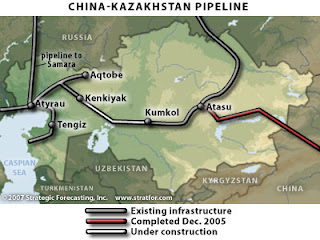
Kazakhstan’s KazStroyService has completed the construction of the Kenkiyak-Kumkol pipeline, giving China direct access to Kazakhstan’s oil provinces in western Kazakhstan, Reuters reported citing an announcement by KazStroyService.

KazStroyService reportedly successfully completed the first test oil shipment.

The Kenkiyak-Kumkol link is the third part of the so-called Kazakhstan-China pipeline which runs from Atyrau near the Caspian Sea to Alashankou in China’s northwestern Xinjiang region. The first stage of the project was completed in 2003 and runs westward across Western Kazakhstan from the oil fields of the Aktobe region to Atyrau. This line will be reversed when all stages are complete. The second stage from Atasu, in northwestern Kazakhstan, to Alashankou was completed in 2006. The newly completed Kenkiyak-Kumkol pipeline will connect the two links and will give China access to CNPC’s Aktobe and Kumkol fields and the newly acquired MangistauMunaiGas upstream assets.

Kazakhstan and China agreed to build the 3,000 km pipeline in 1997 and have said they would later double the capacity of the combined pipeline from the current 10 million tons a year.

China extended a $10-billion loan to Kazakhstan in April in exchange for greater access to the country’s hydrocarbon wealth. Already, with CNPC’s recent purchase of a 50-percent stake in MangistauMunaiGas, China’s share in Kazkahstan’s oil production amounts to 22 percent, a local financial newspaper reported recently citing government data.

China is also building a pipeline to import up to 40 billion cubic meters of Central Asian gas a year. The link originates in Turkmenistan and goes through Kazakhstan and Uzbekistan.
(Silk Road Intelligencer)