Visualizzazione post con etichetta Nabucco. Mostra tutti i post

12/20/2012

SOUTH STREAMING.

Russia's Gazprom said construction would begin this week on the underwater section of its South Stream pipeline, which will carry natural gas beneath the Black Sea and into the European Union.

But is this really the case?

Gazprom CEO Aleksei Miller announced last month that the final investment decision for the project had been reached. Miller attended a groundbreaking ceremony near the town of Anapa on Russia's Black Sea coast on December 7.

However, as Johnatan Stern, head of the Natural Gas Research Program at the Oxford Institute for Energy Studies notes, Gazprom hasn't yet ordered pipe or organized the lay barge for the pipeline and "cannot start laying the offshore section until 2014 [at the] earliest."

Moreover, EU officials say a final route has yet to be submitted to Brussels and likely won't have final approval for at least another year.

RFE/RL has also learned that EU Energy Commissioner Guenther Oettinger declined an invitation to attend the groundbreaking, citing previous commitments.

Marlena Holzner, the spokeswoman for the EU energy commissioner, says this means that a final investment decision on South Stream -- a phase after all designs and studies have been completed and official approvals are in hand -- isn't even in sight.

"We have no concrete information that, indeed, the final investment decision on South Stream has been taken already because normally, if you use this term in a general sense, you would have different things established before you can say it's a final investment decision," Holzner says. "And one is that you have the route.

"To the European Commission, it has never been communicated that there is a final route. That means where South Stream starts, where it ends, and which countries the exact route goes through. That has not been done," she continues. "There is no environmental impact assessment for the whole route. As far as we can see it, we don't regard this as a final investment decision."
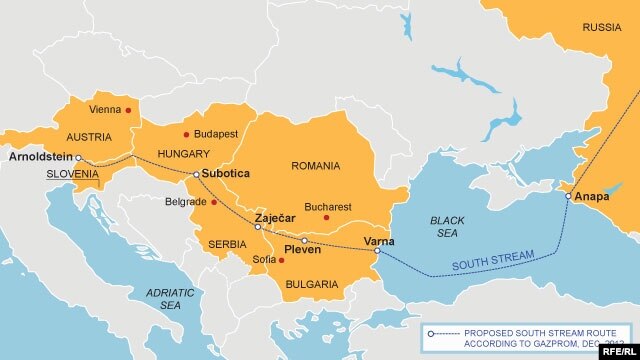
The proposed South Stream pipeline route, according to Gazprom
​​
Gazprom says South Stream will pass through Turkish waters to Bulgaria, then continue on through Serbia, Hungary, Slovenia, and Austria to tie in with the distribution network of the multinational Eni in northern Italy.

Officials in Brussels say they see South Stream's current status as moving from the "conceptual design and feasibility" stage to the "front-end engineering and design" phase.

In the latter phase, EU legislation requires numerous tasks that need approval from regulators in each country along the route and from the European Commission itself.

Russia says it has concluded intergovernmental agreements needed with each EU country involved, but the European Commission hasn't yet seen them all.

The deadline for EU states to submit those documents to Brussels is February 16, 2013. The commission then has nine months to assess the agreements and raise its doubts and concerns.

A detailed plan for the entire route must be submitted to Brussels, which also must approve environmental and social impact studies by national regulators in each EU country.

A "transboundary assessment" is also required, with input from EU states adjacent to the route. All studies require consultations with the public and authorities in each country and could take more than a year to complete.

Moreover, the offshore section of the pipeline entering Bulgaria must undergo an EU environmental-impact study to ensure it complies with environmental directives.

Russian-European Chamber of Commerce President Sergei Shuklin confirmed that the December 7 ceremony at Anapa will mostly be a ribbon-cutting affair without underwater construction activity.

"Yes, yeah, I agree with that. But it starts," Shuklin said. "Actually, by this action, Russia showed they are serious about this project. They are just going to make it happen. I'm pretty sure.... So they will have the first communications with the European Commission, with the governments of the countries participating in this project. So everything will be concluded [according to EU legislation], especially [since] Russia just became a member of the World Trade Organization."

So why did Gazprom rush to make its announcement?

Shuklin suggested it could be related to a probe launched in September by the European Commission into allegations that Gazprom engaged in anticompetitive practices in Central and Eastern Europe.


"Russia was actually surprised with the action related to Gazprom," he said. "And so probably, one of the reasons was, 'Yeah, let's just do it our way. We know people from the countries where we will build the pipe, and at this point, deal less with the European Union government.'"

Robert Cutler, a research fellow at Carleton University's Institute of European, Russian, and Eurasian Studies in Canada, maintains that Gazprom's push to announce the start of construction work on South Stream could also be related to domestic politics.

"On live Russian television, [President] Vladimir Putin gave [Prime Minister] Dmitry Medvedev a direct order: Construction of the pipeline should begin by the end of 2012," Cutler said. "There's a certain amount of prestige domestically invested now in producing some sort of result, even though physical construction of the pipeline probably was not in the cards then and certainly is not now.

"If Putin gives this order and Medvedev says, 'We'll do it,' but it doesn't end up happening, it raises questions domestically about their authority within the factions in the Kremlin and about Gazprom's credibility overall internationally."

According to Cutler, another reason is to give the appearance that South Stream is progressing faster than the Nabucco pipeline, a rival U.S.-backed project aimed at reducing Europe's dependence on Russian gas by linking the Caspian region and the Middle East to EU markets. 

6/03/2011

RUSSIAN CUCUMBERS. (Cetrioli alla russa)

Dunque dopo la mucca pazza, la Sars, l’aviaria e la suina è arrivato il cetriolo killer. Le vittime causate da questa variante del batterio Escherichia Coli sono certamente tante, sempre troppe. Tuttavia, anche stavolta, il rischio è che a livello mediatico venga instillata la psicosi collettiva della pandemia. Insomma, abili operazioni di spin a vantaggio dei soliti noti, case farmaceutiche in testa.

Nel frattempo accadono due cose. Anzitutto i paesi europei si scannano come al solito tra loro, accusandosi l’un l’altro d’aver dato inizio al contagio. Zapatero ha già chiesto a Berlino un risarcimento di almeno 200 milioni di euro per il danno economico d’immagine provocato dalle insinuazioni tedesche. Dal canto suo la Russia, e questo è il secondo aspetto rilevante, ha pensato bene di chiudere temporaneamente le proprie frontiere agli ortaggi comunitari. Proprio così, a tutti gli ortaggi, dal momento che non si è ancora sicuri dove risieda effettivamente questo batterio killer.

Ovviamente a Bruxelles si è gridato al sacrilegio. Frederic Vincent, portavoce del commissario alla salute dell'Unione Europea s’è affrettato a definirla una “misura sproporzionata”. Proporzionatissimo era invece il blocco alle importazioni di pollame proveniente dalla Russia deciso dalla Commissione Europea ai tempi dell’aviaria. Due pesi e due misure. Ma si sa, noi europei abbiamo la memoria corta, anzi cortissima.

Il fatto è che sul piatto della contesa non ci sono solamente gli ortaggi. Anche per i poderosi stomaci russi i cetrioli possono essere particolarmente indigesti. Ma ancora più indigeste possono essere le liberalizzazioni energetiche, come quella contenuta nel “terzo pacchetto” Ue che prevede la separazione tra produzione e distribuzione. Unbundling è il termine tecnico.

Angry è invece stata la reazione di Putin al vertice energetico Russia-Ue dello scorso febbraio. Il terzo pacchetto è senza dubbio un pugno al ventre delle ambizioni di Mosca di tener ancorato a sé, per mezzo dei tubi, il Vecchio Continente. Per il momento inutili i tentativi del premier russo di far leva sugli accordi energetici siglati con i singoli stati dell’Unione, così come inutile è apparso il tentativo di convincere Barroso del rischio di un aumento dei prezzi affidando le reti di distribuzione a piccole compagnie alternative a Gazprom.

È noto che tra Putin e Barroso non scorra buon sangue. Alcuni file di Wikileaks non fanno che confermare quanto già risultava evidente ai tempi della crisi georgiana del 2008, quando il presidente della Commissione Europea minacciò di cessare l’acquisto europeo di gas russo se Mosca non avesse interrotto immediatamente le operazioni militari. Com’era prevedibile il messaggio entrò da un orecchio di Putin ed uscì subito dall’altro suo orecchio: in attesa dei gasdotti made in Usa che bypasserebbero il territorio della Federazione, per l’Ue il gas russo è semplicemente irrinunciabile.

Al contrario l’unbundling è per Putin una minaccia seria. Una misura che rischia veramente di allentare i cordoni di Mosca sull’Unione Europea. Un fattore di disturbo per la politica russa del “cortile di casa” est europeo.

Perciò Il blocco alle importazioni di ortaggi europei non può che essere interpretato anche come una ritorsione alle misure energetiche decise da Bruxelles. Una vendetta, che come si sa, è un piatto che va servito freddo. Senza l’ausilio di un fornello a gas.
Proprio come i cetrioli alla russa.

Ingredienti : cetrioli - sale - pepe - olio - aceto - prezzemolo - crema di latte.

Mondate i cetrioli e ritagliateli in fette finissime. Raccogliete queste fettine in una piccola insalatiera e cospargetele con un po' di sale fino, per privare il cetriolo della molta acqua di vegetazione che contiene.
Dopo una mezz'ora prendete un po' di fette alla volta, strizzatele e spandetele sopra un tovagliolo che poi arrotolerete pian piano.
Le fettine così rinchiuse si asciugano perfettamente.
Dopo un altro po' di tempo accomodate le fettine nei piattini da antipasto, conditele con pochissimo sale, pepe, olio, aceto e prezzemolo trito, aggiungendo una cucchiaiata o due di crema di latte sciolta.
Mettete i piattini preparati in frigo per almeno un'ora, affinché i cetrioli possano essere serviti freddissimi.
(Pubblicato su 24Emilia)

2/09/2011

THE ORIGINAL PURPOSE. (Lo scopo originale)

Ukrainian President Viktor Yanukovych clinched energy pacts with Azerbaijan on Jan. 28 and attacked Russia for plans to bypass his country in supplying gas to Europe, reviving market fears of regular spats between Moscow and Kyiv.

Markets were relieved when Yanukovych, perceived as friendlier to the Kremlin than his predecessor, Viktor Yushchenko, was elected Ukraine’s president last year.

That followed five years of disputes between the ex-Soviet neighbors, marked by mid-winter cuts in Russian gas supplies to Europe that represent a quarter of the continent’s total needs.

But Yanukovych has played a much less pro-Moscow role than expected since taking office, saying the European Union was an equally or even more important partner than Russia.

Speaking at the World Economic Forum in Davos, the president lashed out at new Russian pipeline projects and signed oil and gas deals with Azerbaijan to cut Ukraine’s reliance on Russia.

Yanukovych said Ukraine shared Poland’s concerns about political motives behind the Nord Stream pipeline to supply Russian gas to Western Europe along the Baltic Sea floor, bypassing central European nations.

“Another project being discussed today between Russia and Europe is the construction of South Stream. This possibility is directly related to Ukraine and here I share the position of Poland,” he said, referring to a project to pipe gas under the Black Sea to southern Europe.

Russia ships about 80 percent of its gas exports to Europe through Ukraine now and the remaining 20 percent via Belarus and says it needs the new projects to boost Europe’s energy security after disruptions in previous years.

Yanukovych said South Stream would cost $25 billion while it would cost much less to upgrade Ukraine’s pipeline system.

“Why are our partners today pretending that there is no alternative? A year ago we proposed a project that would cost five times less – not more than $5 billion, it would come to the same destination points to which South Stream would go.”

“That’s why we ask the same question, speaking eye-to-eye with our partners, and we are still waiting for an answer.”

“If this is a way to exert pressure, not a commercial project, then of course serious questions arise about how we should build our relations today, let alone in the future.”

Yanukovych used the Davos platform to sign a deal with Azeri President Ilham Aliyev to import liquefied natural gas to a planned Ukrainian terminal aimed at reducing the country’s heavy dependence on Russian gas. The memorandum did not specify volumes for the terminal to be opened in 2015. He also signed a memorandum on cooperation in shipping Azeri oil across Ukraine.

Yanukovych said Ukraine would ship the first million tons of Caspian Sea oil to Europe via the pipeline this year, thus ending its use to export Russian crude to the Mediterranean.

“The Odessa-Brody pipeline has been used in various directions. Very soon we will start working according to the original idea, delivering oil from Odessa to European countries,” he said.

Interfax news agency quoted Ukrainian officials as saying the deal covered deliveries of up to 4 million tons a year.

Aliyev, who spoke at the same panel, said he was under no pressure from Russia to shun the Nabucco pipeline, seen as a key European Union’s attempt to reduce reliance on Russian.
(Therearenosunglasses's weblogs)

11/30/2010

TOO MANY PIPELINES. (Troppe pipeline)

Europe may not be able to sustain all its proposed gas supply pipelines but will need to build at least some soon to ensure security of supply in the latter half of this decade.

Scarred by the Russia-Ukraine gas row of 2009, which cut about a fifth of Europe's supply in mid winter, major European gas consumers plan many pipelines to promising producing regions in central Asia, North Africa and the Middle East.

With China competing to woo producers, Europe will likely struggle to secure enough gas to fill all the new connections and would be unable to use it all if they do get filled.

"If every project that is discussed is built then there will be way too much supply, so I think the best projects will be developed and marginal ones delayed, or not built," said Graham Freedman, a senior analyst at UK consultancy Wood Mackenzie.

"But I don't think anybody doubts the fact that Europe is going to need more gas because domestic production is falling. It is going to be an importer for many years to come," he said.

Wood Mackenzie forecasts that gas demand in the European Union, Turkey and former Yugoslav states could rise from 551 bcm in 2010 to 653 billion cubic metres in 2020.

Under what it says is a bullish demand scenario, this would leave a supply shortfall of 125 bcm by the end of the decade unless far more is produced at home or brought in from overseas.

But if all major new pipelines were built and filled to capacity, gas flows to Europe by 2020 could far outstrip demand.

Since the Russia crisis, Europe has been comfortably supplied with gas for power generation, heating and industry through existing pipelines and an increasing number of liquefied natural gas (LNG) tankers. The Medgaz link from Algeria to Spain could further increase supplies into the Iberian Peninisula by 8 bcm/year, if the repeatedly delayed pipeline opens this winter.

The 55 bcm/year Nord Stream pipeline under the Baltic Sea is expected to bring more Russian gas to western Europe, bypassing Ukraine by the end of next year.

Russia is pushing on with its South Stream project to bring up to another 63 bcm under the Black Sea via the Balkans.

The European Union is also championing the 31 bcm alternative Nabucco plan that would bring Caspian and Middle East gas via Turkey, excluding Russia.

But Italy also hopes that its projects TAP and ITGI for around 10 bcm capacity each can compete for mainly Caspian gas market share with South Stream and Nabucco, giving it more options via the "Southern Corridor" to Europe.

In all, the maximum capacity of these pipelines, some of which were conceived prior to the economic crisis which brought a gas price slump, adds up to 177 bcm to Europe's supply.

Pipeline supplies would also face competition from liquefied natural gas (LNG), which has become much more readily available because of a surge in North American shale gas production, with unconventional gas finds in Europe posing another threat to both types of external supplier.

"Some projects make sense from a security of supply perspective, because of the diversification of gas sources that they would bring," said Nigel Harris of UK consultancy Kingston Energy. "But with plenty of gas available from existing sources, there's no commercial benefit from diversification."

Nord Stream and South Stream are just additional routes for Russian-controlled gas flows, he said, while alternative sources from Azerbaijan, Turkmenistan and Iran remain uncertain.

The International Energy Agency (IEA) thinks global gas demand may recover from 2011, but it still expects supply to outstrip demand until 2020..

Some gas suppliers are more optimistic, pointing to buoyant demand in the Middle East, China and India which could leave less gas for Europe. Phillipe Boisseau, president of France's Total Gas & Power, told the recent European Autumn Gas Conference in Berlin that the "supply bubble will disappear in three years."

Speakers agreed that current gas prices in consuming countries would not support all Europe's proposed supply lines, although they expect demand for power generation to contine to rise as Europe looks to back up its increasing wind power capacity with gas-fired plants.
(FuturesPros.com via Reuters)

11/15/2010

BULGARIAN MAJORITY. (Maggioranza bulgara)

Russia and Bulgaria signed on Saturday accords to push ahead with the South Stream natural gas pipeline aimed to deliver gas to central and south Europe and cement Moscow's hold on European energy supplies.

Russian Prime Minister Vladimir Putin and his Bulgarian counterpart Boiko Borisov attended the signing of accords to set up a joint venture for the Bulgarian section of the project aimed at shipping Russian gas under the Black Sea to Europe.

'Today, a shareholder accord and a charter of the joint venture were signed. By doing this, we made one more serious step towards implementation of mutual agreements,' Putin told a news conference in Sofia where he arrived on a working visit.

The South Stream pipeline, controlled by Gazprom and Italy's ENI is planned to transport up to 63 billion cubic meters of gas to central and south Europe, bypassing countries such as Ukraine, at the end of 2015.

The link, in which French EDF is set to get a stake of no less than 10 percent, is a rival to the European Union-backed Nabucco pipeline, designed to bring gas from central Asia and the Middle East and reduce Europe's dependence on Russian deliveries.

Russia, the world's largest energy exporter, supplies Europe with a quarter of its gas needs. Analysts estimate European demand for Russian gas could rise to 30 percent by 2030.

Brussels and Moscow have been competing to sign up potential countries and suppliers for their projects.
The European Union member Bulgaria supports both projects, which are planned to run through its territory and has expressed concerns over delays in the Nabucco pipeline development.

'We are also working on the Nabucco pipeline with the same speed ... Bulgaria's interest is to transit gas through both pipelines,' Borisov told reporters.

His government, which put on review all Russian-backed energy projects last July, pledged to speed up work on South Stream after Gazprom promised to lower gas prices for Bulgaria, almost fully dependent on Russian gas supplies.

The Balkan country agreed to further accelerate work on the project in October, when Gazprom indicated South Stream could bypass it and run through Romania.

South Stream has also secured backing from Austria, Croatia, Greece, Hungary, Serbia and Slovenia.

Gazprom and state-controlled Bulgarian Energy Holding, which will have 50/50 stakes in the new venture, have already opened a tender to seek contractors for a feasibility study for the Bulgarian section, estimated to cost $835 million.

Bulgaria secures about 70 percent of its energy needs through imports. It gets almost all of its gas from Gazprom, its only nuclear power plant Kozloduy is Soviet-made and its only operational oil refinery is owned by Russia's LUKOIL.

Putin said LUKOIL was set to invest up to $2 billion more in its Bourgas-based oil refinery, Lukoil Neftochim.
Bulgaria and Russia also discussed the Belene nuclear power plant project, which Sofia had also put on hold due to a lack of funding and strategic partners.

Sofia has said it will push ahead with the 2,000 megawatt plant, for which it has contracted Russia's state Atomstroyexport, only if backed by strategic European investors.

Borisov has indicated Bulgaria is close to finding a partner in Germany for Belene, estimated to cost over 7 billion euros.

Bulgaria's warming towards the projects has irked Washington and Brussels which are encouraging Bulgaria to lessen its heavy energy dependence on Russia.

Belene froze last November, when German energy giant RWE , which had agreed on a 49 percent stake, pulled out.

Sofia wants to build Belene so as not to lose hundreds of millions of euros it has already invested and to avoid paying hefty compensation to the Russian contractor, Atomstroyexport.
(XE, via Reuters)

10/14/2010

ALL AT THE ZAR COURT. (Tutti alla corte dello zar)

Alcune compagnie energetiche tedesche hanno espresso il desiderio di partecipare al progetto South Stream. E’ quanto emerge dall’incontro Berlusconi-Putin di domenica scorsa. Ecco che le ali del Nabucco sono sempre meno dorate e, se le cose continueranno per questa china, il progetto energetico europeo non andrà lontano. Nabucco è infatti il nome dato al gasdotto che dal mar Caspio dovrebbe rifornire i Balcani fino all’Italia e all’Austria. Lo scopo della sua costruzione è eminentemente geopolitico: estendere l’influenza “occidentale” sui Balcani e sul Caucaso. La sua progettazione è precedente all’adesione all’Unione Europea dei Balcani orientali e si profila quale strumento di persuasione a restare in orbita europea per i Paesi che vedono procedere a rilento il loro percorso di integrazione. Nabucco nasce come concorrente del South Stream russo poiché, si ragionò giustamente, dipendere dalla Russia nel settore dei rifornimenti energetici significherebbe perdere larghe fette di sovranità: come criticare la diplomazia di Mosca nel campo dei diritti umani se dal Cremlino controllano i rubinetti del gas? Come osteggiare la politica estera di Mosca, le guerre in Cecenia e in Georgia, l’assalto all’Artico, le ingerenze in Ucraina, se si diventa servi del gas russo? E ancora: come affermare l’autonomia dell’Unione di fronte a un duplice vassallaggio, militare-americano da un lato e russo-energetico dall’altro?
Ma sul Nabucco si è investito poco e male. L’Italia e l’Eni sono state le prime a capire che non c’era di che ingrassarsi col progetto europeo e si son subito vendute al “rivale” russo. Eni e Gazprom diventano così partners per la costruzione del South Stream con tanti saluti all’europeo Nabucco. L’Italia, che con difficoltà si annovera tra le democrazie compiute, predilige fare affari con Putin e Gheddafi. La torta russa piace non solo agli italiani, ecco che la Edf (Electricité de France) entra nella joint-venture con Gazprom ed Eni. Lo scorso giugno 2010 Nicolas Sarkozy vola a San Pietroburgo alla corte dello zar per sottoscrivere l’affare.

Ora anche i tedeschi vogliono partecipare all’abbuffata. “Benone” esclama Berlusconi in visita presso l’amico Putin, in questo modo sarà possibile riscuotere l’interesse dell’Unione Europea finora rimasta fredda nei confronti del South Stream. I tedeschi, va detto, già sono partner di Gazprom per la costruzione del gasdotto North Stream, quello che aggira repubbliche baltiche e Polonia (ree di scarso amore verso lo zar) e va dritto in Germania; quello sottoscritto a inizio anni Duemila dall’allora cancelliere Schroeder, attratto dall’oro azzurro russo, poi divenuto dirigente Gazprom e responsabile proprio del consorzio North Stream; quello per cui in Polonia si stracciano le vesti gridando a un nuovo patto Molotov-Ribbentrop.

Rumors indicano nella Basf il nome dell’azienda energetica tedesca pronta a unirsi ai tre moschettieri Gazprom, Eni, Edf. Un’ulteriore mazzata al progetto Nabucco per il quale la Banca europea per gli Investimenti (Bei) e quella per la Ricostruzione e Sviluppo (Bers) hanno appena stanziato altri 4 miliardi di euro, segno che l’affrancamento energetico dell’Europa dalla Russia è considerato prioritario da Bruxelles che si trova a dover gestire tre serpi in seno assai velenose.

Una nota finale: il Nabucco parte dall’Iran, via Tabriz ed Erzurum. Proprio ad Erzurum raccoglie il braccio che s’avvia da Baku e passa per Tiblisi. Poi va verso Ankara, Istanbul e l’Europa. Il governo italiano si è sempre mostrato molto duro nei confronti del regime degli Ayatollah, ai limiti dell’ottusità, e si è detto favorevole all’intervento militare a stelle e strisce mentre, per ragioni che dopo questo lungo discorso parranno ovvie, non ha mai detto “beh” sul massacro in Cecenia.

I partners del Nabucco, inoltre, stanno tutti cambiando casacca: L’Azerbaijan si è vincolato con Mosca, e ben poco della sua produzione resterà a Bruxelles, ma il Cremlino ha promesso protezione e denari in quantità al regime di Baku. Il Turkmenistan, altra dittatura, è da pochissimo entrata in affari con Eni e Gazprom e punta a rifornire la Cina più che l’Europa.
L’Iran -grazie anche all’intervento americano- è assai indietro nello sviluppo dei suoi giacimenti. Ecco allora che non resta che prendersi in faccia l’ironia di Putin: “Che Dio li aiuti -ha dichiarato- il Nabucco è un tubo vuoto e il consorzio che lo sta sviluppando (l’austriaca Omw, l’ungherese Mol, la rumena Transgaz, la Bulgargas, la tedesca Rwe e la turca Botas. ndr) non fornirà nemmeno un metro cubo di gas fino al 2018 mentre fra un anno il South Stream sarà pronto”. Con buona pace della democrazia europea.
(East Journal)

3/26/2010

ENI'S BETRAYAL. (Il tradimento dell'Eni)

Europe should unite efforts to secure natural gas by linking the South Stream and Nabucco pipelines, officials at Italian energy giant ENI said.

European leaders should increase investments in infrastructure needed to secure "new sources" of natural gas from locations such as Turkmenistan, Kazakhstan and Africa, said Paolo Scaroni, the chief executive at Italian energy giant ENI.

Scaroni told delegates at the CERAWeek energy conference in Houston that diversity was the key to the global energy sector of the future.

"In the decade ahead, and probably well beyond that, the world energy scene will be increasingly dominated by the consumption of gas and the supply of gas," he said.

Scaroni said European leaders would benefit from linking rival pipeline projects Nabucco and South Stream, Russia's ITAR-Tass news agency adds.

"If only all partners decided to link the two, we would reduce operating costs and increase efficiency," he said.

A troubled relationship between gas host nation Ukraine and supplier Russia prompted a race to diversify the European energy sector.

The European Commission recently allocated billions of dollars to fund the construction of the Nabucco gas pipeline to move non-Russian gas through Turkey.

Moscow, meanwhile, aims to avoid Ukrainian territory with its South Stream gas pipeline through the Balkans.

ENI is a major partner in the South Stream project along with Russian gas giant Gazprom.

(UPI)

----------------------------------------------------------------------------------

Russia is not considering a proposal to combine part of its South Stream gas project with the Western-backed Nabucco pipeline, Energy Minister Sergei Shmatko said on Monday.

"We are not discussing such issues," Shmatko said.

Shmatko commented on a recent suggestion by Italy's Eni SpA, Gazprom's partner in the South Stream gas pipeline project, that combining some sections of the pipelines would cut costs and boost profits.

Eni CEO Paolo Scaroni was reported to say at a Cambridge Energy Research Associates conference in Houston on Wednesday that if all the partners decided to merge the two pipelines for part of the route, "we would reduce investments, operational costs and increase overall returns."

Shmatko also said Russia welcomed Europe's desire to diversify gas supply routes but did not consider the South Stream and Nabucco as rival projects.

Both South Stream and Western-backed Nabucco aim to supply natural gas to Southern and Central Europe. The South Stream project is designed to deliver up to 63 billion cubic meters of Central Asian and Russian natural gas under the Black Sea while Nabucco is intended to pump 31 billion cu m of natural gas from the Caspian region via Turkey.

Russian experts, however, are skeptical about the prospects of merging the two pipelines as Nabucco was originally designed to cut Europe's dependence on Russian natural gas deliveries.

(RIA Novosti)

12/01/2009

MULTI-VECTOR ENERGY POLICY. (Una politica energetica multivettoriale)

Kazakhstan wants to leave politics out of the equation and make a profit when dealing with the transport of hydrocarbons, the country’s foreign minister told five visiting western journalists at his lavish ministry in Astana.

“The fundamental principle from which we are proceeding on exporting our resources is the principle of economic feasibility - no politics there.

We have exported and will be exporting in any direction that is profitable for us,” Kanat Saudabayev said on 23 November. He was responding to a question from New Europe on whether the energy-rich former Soviet republic had any preference over Russian, Chinese or EU-bound projects competing for its rich oil and gas resources.

The relatively new foreign minister reminded that the Turkmenistan-Kazakhstan-China gas pipeline is due to be inaugurated on December 15 and there is already an oil pipeline from western Kazakhstan to western China. Kazakhstan also exports its oil through a whole system of pipelines running through Russia (CPC). Moreover, Kazakhstan ships oil through the Aktau-Tbilisi-Ceyhan pipeline system.

“Given that we will be producing 170 million tons of oil out of which 130 million tons of oil will be available for exports it is in our deep interests to see the multiple export pipelines realized,” Saudabayev said. The bulk of the new volumes would come from Kashagan’s massive oil field, which plans to start commercial production around 2015. “Kazakhstan is and has been turning into a more significant player on the energy market for the European consumers and we will continue to export oil resources through those means that are profitable for us. Kazakhstan as a partner has always been distinguished by its reliability and predictability,” Saudabayev said.

The question is how this oil will be transported. There are several options, including the expansion of the CPC pipeline to Novorossiysk and also using the route to China.

Regarding the issue of bypassing the crowded Bosporus, the Burgas-Alexandroupolis oil pipeline seems to have stalled. Russia seems to prefer the Samsun-Ceyhan pipeline route through Turkey due to foot-dragging by Bulgaria but also to lure Turkey into supporting the South Stream gas pipeline over Nabucco, Chris Weafer, chief strategist at Uralsib bank, told New Europe from Moscow.

“I assume that both by-pass pipes will eventually be built to cut congestion in the Bosporus. Russia will want to send more shipping with non-oil cargos via the narrow channel as it expands the economy and operations at Novorossiysk port. So it needs to divert as much oil into pipes as possible as quickly as possible,” Weafer said. Kazakh President Nursultan Nazarbayev supported Samsun–Ceyhan during his latest visit to Turkey.

Asked by New Europe if Kazakhstan was economically interested in the Nabucco pipeline, Kazakhstan’s Minister of Economic Affairs and Budget Planning Bakhyt Sultanov said that his country is interested in different ways to export its oil and gas resources. “In the case of Nabucco the main question is resources. If we’ll have resources we can sell through Russia, through Nabucco, though our partners,” he said at the sidelines of a forum to discuss Kazakhstan’s OSCE chairmanship and its priorities.

For now, it seems as if Nabucco has been out-maneuvered by Russia and China and is in real danger of having nowhere to turn to for gas supplies. “The commercial case for South Stream and Nabucco looks increasingly unsound,” Weafer said. “They are both now political projects.”
(Gazeta.kz)

10/26/2009

BERLUSCONI'S MOST IMPORTANT FLIRT (Il flirt più importante di Berlusconi)

Silvio Berlusconi and Vladimir Putin, meeting in St Petersburg, have given new impetus to the race to supply gas to Europe. The Italian prime minister is joining his Russian counterpart in pushing the South Stream project over another pipeline backed by the EU. The announcement followed discussions by video phone with Turkey’s Prime Minister Recep Tayyip Erdogan.

South Stream, said Putin, had to be constructed quicker than North Stream, a third pipeline that will run under the Baltic Sea and then pass through Scandinavia. The Russian premier said it was possible because the three countries already had experience working together on another building project on Turkish soil, the Blue Stream construction.


South Stream is a joint project involving Russia’s Gazprom and Italy’s ENI. After running under the Black Sea, two possible routes are being studied to supply gas to western Europe.
The agreement was sealed back in August during a one-day visit by Vladimir Putin to Ankara. The Turkish prime minister said he saw South Stream as a parallel rather than a rival project to the EU-backed Nabucco pipeline – as both would be needed in the future.


---------------------------------------------------------------------------------


The three leaders had a comprehensive talk concerning the South Stream pipeline project, which is to be constructed jointly by Russia’s Gazprom and Italy’s Eni. Putin remarked that issues with Turkey had been resolved, referring to the announcement earlier this week of Turkey’s decision to allow geological exploration in its Black Sea economic zone as part of the South Stream project.


Berlusconi, who is currently in Russia, mentioned on Wednesday the cooperation between Turkey and Italy in the field of technology and the helicopter manufacturing plant that is being established in Turkey through an equal partnership between Italy’s Agusta and a Turkish company. Italy is ready to establish similar partnerships with Russia, too, he added. Berlusconi had also attended talks during Putin’s visit to Ankara on Aug. 6.


PM Erdoğan held a teleconference with Russian and Italian prime ministers on energy issues.
Earlier this week, Turkey, Russia and Italy signed a memorandum of understanding on the Samsun-Ceyhan oil pipeline in Milan. The project will be carried out by the Trans-Anatolian Pipeline Company (TAPCO) in which Italian energy company Eni and Turkish company Çalık Energy each hold a 50 percent stake.


The South Stream project is set to eventually run from Russia to Bulgaria under the Black Sea before delivering gas to consumers in Europe. The pipeline, with an annual capacity of 63 billion cubic meters, is planned to be operational in 2016, costing $11.6 billion.

9/15/2009

ASTANA SEEN FROM ROMANIA (Astana vista dalla Romania)

The State Secretary of the Romanian Ministry of Economy, Tudor Sherban, spoke in an interview with Trend Capital correspondent.

Cooperation in energy was discussed during the eighth session of the Kazakh-Romanian inter-governmental commission on trade and economic cooperation in Astana today. You mentioned two projects - "Nabucco" and "Constanta - Trieste".

How does Romania appreciate Kazakhstan's participation in two these projects?

We think that the role of Kazakhstan in the Nabucco project is very important. Kazakhstan has its own gas reserves. It is known that Kazakhstan participates in some projects in Turkmenistan. So, certain gas reserves can be directed to the "Nabucco" from there.

Moreover, part of those gas volumes, which are under contracts with Russia, can be also supplied to "Nabucco". But it will be possible with the consent of all parties. The recent visit of Russian Prime Minister Vladimir Putin to Turkey encourages on this regards.

As Romania is involved in "Nabucco", I think that it will be possible to agree in coordination with other partners given other projects which Russia promotes in our region (the Balkans).

Azerbaijan is important partner for us in the Caspian region. it is our reliable gas supplier. We know that Azerbaijan has expressed its intention to participate with its gas in the Nabucco project. We welcome and fully support this decision. Moreover, Azerbaijan has strategically important location in the junction of transportation routes.

I would like to inform that Romania has plans to build a new terminal in Constanta for liquefied gas storage.

How do you appreciate Kazakhstan's participation in the project pipeline 'Constanta - Trieste'?

The Kazakh side made a request to participate in the negotiations on the project a year ago. It means for us that Kazakhstan is interested in participating in this project. At present, the project of "Constanta - Trieste" pipeline is at the stage of organizing. A consortium has been already established and its head has been appointed. But, unfortunately, one of the participants of the project - Croatia has blocked the course of negotiations and actions.

But the issue concerning drawing investments will occur soon, when goals of each company from the countries-participants of the project, through which the pipeline is laid, are defined.

From our point of view, Kazakhstan will be able to participate in this project, along with Romania. If it enters with investments, it will automatically mean that Kazakhstan can have certain package of shares.

What Kazakh share is indicated in the project?

It is difficult to name any specific figure without development of feasibility study. But when it is ready, it will be known about shares of all sides after determining the cost. Kazakhstan will be able to join the project as oil supplier in future. Thus, Kazakhstan can enter the center of Europe through Romania, providing its oil via Constanta - Trieste pipeline.

It dealt with establishment of energy bridge of Batumi - Constanta at one time. What are its prospects?

We hope that the geopolitical climate in the South Caucasus will stabilize. Georgia has great importance to ensure transit routes and gas, oil and other goods supplies, to Europe. We hope that the situation will normalize, because one can not talk about politics without economy, and Batumi is an important transportation hub in the region.

Moreover, the Black Sea and Batumi port are direct access to Europe. Therefore, stabilization of the situation in Georgia is in interests of the same Caspian countries to have direct access to the Black Sea.

How do you assess entry of the national KazMunaiGaz on the Romanian market by buying shares of Rompetrol?

Positively. At present, our companies, including the national oil company, OMV, faced with fierce competition in the person of KMG. But these are the laws of the market. It is very good. As a recommendation, I would like to advise KMG to be more transparent with the Romanian public authorities.
(Gazeta.kz)

8/25/2009

SUSPICIOUS SILENCE. (Silenzio sospetto)

The recent signing of the Nabucco pipeline project is definitely a political rather than economic deal. Its feasibility, the probability of its actual construction and its profitability aside, the deal shows clearly that, at least for the present, those who want to see a weaker Russia prevail over those who would rather see it strong and an integral part of the West. It is also obvious that without heavy Washington lobbying the Nabucco pipeline would never take off. Since there is practically no economic interest for the U.S. in it, Washington politics make the direction of the much advertised "reset" quite uncertain.

In the last 20 years since the collapse of communism every U.S. president has kept repeating that it is in American interests to see Russia as a strong, democratic, and prosperous nation. But actions rarely suit the words. Washington needs, and often gets, Moscow’s cooperation on major security issues, but then it turns around and does its damnedest not only to prevent “non-democratic” and “authoritarian” Moscow from becoming an energy superpower, but to make sure that it gets as little cash as possible -- by diverting this cash to former Soviet republics where democracy is so rudimentary as to be barely discernible, while Oriental despotism, sometimes hereditary, is very much in evidence. So much for the hugely advertised U.S. democracy promotion mission.

OK, let us forget about democracy and get to real things. Has in the end Russia lost this round? What about another important problem for Nabucco - the Iranian connection? It is more or less obvious that this new pipeline will be extremely difficult to fill. If one excludes Russian and Iranian gas it would be practically impossible to do. That is why Turkey insisted that both Russia and Iran should be on the list of gas suppliers but then the whole idea of Nabucco of eliminating Russia from the supply equation did not materialize. Pretty soon the Nabucco lobbyists will have to face squarely some unpleasant questions: Why we should spend billions to enrich Iran or Russia? The next question will be what if both Russia and Iran say that they are not interested since they already have other gas delivery contracts through different routes? Will Nabucco actually bring Russia and Iran closer together to manipulate not only the gas supply line but geopolitics?

Russia provided so much help to U.S. and NATO in Afghanistan. It can do a lot more in Iran since practically the whole Iranian nuclear program is dependent on Russia, which makes RF the best guarantor of it being used for peaceful rather than military purposes.

Of course, Russia made a mistake in accepting Ahmadinejad’s claim for victory in the recent elections a bit too soon. The Iranian opposition is not crushed yet, and the final outcome is not too certain. More and more political leaders and even mullahs are switching sides. The Kremlin would be well advised to show some restraint or at least neutrality, to avoid a future backlash.

Another interesting observation is that Ukrainians, Poles and Balts are suspiciously quiet. They were quite vocal in protesting against the Nord Stream Project to connect Russia with Germany through the Baltic Sea. Ukraine was the most vocal opponent since Nord Stream will bypass it, thus depriving Kiev of the much needed currency and of any chance of blackmailing Russia by delaying gas payments. The Nabucco pipeline -- if it is ever built, of course -- will also bypass Ukraine, but so far it looks like their leaders do not seem to mind. Moreover, they are cheerleading it, so is there some secret protocol to Nabucco regarding Ukraine?

To sum up, the way things are now, the Nabucco project may end up as a hot air balloon, for its economics are pretty questionable while the politics surrounding it smells very bad indeed.

However, one good thing for Russia is that Nabucco should force it to be more aggressive in building the alternative Nord Stream and South Stream pipelines and at the same time spare no effort on its economy diversification so as not to depend too much on its natural resources.
As for Nabucco cheer leaders it is to early for them to celebrate. At the present time I’d not advise to buy the pipeline stocks to anyone but instead want to repeat to some narrow-minded folks that it is a lot more advantageous to have Russia as a friend rather than foe.
(Russia Blog)

8/08/2009

RUSSIAN-TURKISH BARGAINING CHIPS (Merce di scambio russo-turca)

Russian Prime Minister Vladimir Putin's August 6 visit to Ankara marked a new era for "enhanced multi-dimensional partnership," between Ankara and Moscow. Putin and Recep Tayyip Erdogan signed some twenty agreements covering energy, trade and other fields. Italian Prime Minister Silvio Berlusconi also attended part of the talks between Erdogan and Putin, considering the involvement of Italian companies in some of these projects. The most remarkable dimension of the various joint projects concerns energy cooperation, most notably Turkey's expression of support for Russia's South Stream project.

In oil transportation, Russia committed to participate in the planned Samsun-Ceyhan pipeline (SCP), connecting the Turkish Black Sea city of Samsun to the Mediterranean terminal Ceyhan. Turkey has solicited Russian participation in the SCP, which will bypass the congested Turkish Straits. Moscow has proven reluctant, and has instead promoted another bypass option through Burgas-Alexandroupolis between Bulgaria and Greece. Meanwhile, Turkey took further steps to make the SCP attractive for the Russian side, by linking this project with the Turkish-Israeli-Indian energy partnership.

Erdogan expressed his pleasure with the Russian decision to commit its crude. Ankara can consider this development as its greatest success in this grand bargain, given that Turkey has worked to convert Ceyhan, where the Baku-Tbilisi-Ceyhan pipeline also terminates, into a global energy hub. However, Putin did not rule out interest in Burgas-Alexandroupolis, and instead emphasized that the two pipelines might be complementary in meeting the growing demand for export routes. This statement raises questions about how committed Russia will be to the SCP, given that Russian companies own the majority of shares in the other Burgas-Alexandroupolis option.

In terms of gas cooperation, Turkey will allow Russia to conduct explorations and feasibility studies in the Turkish exclusive economic zone in the Black Sea, as part of Russian plans to construct South Stream. Since this move comes against the background of Turkey's decision to sign the rival Nabucco pipeline agreement last month, it raises many questions, as to how it will affect Nabucco, which Turkey considers a "strategic priority," as well as European energy security issues. Despite the questions surrounding its feasibility and high costs, as well as its negative implications for Nabucco, Erdogan maintained that both projects contribute to diversification efforts.

It appears that the "grand bargain" was between the SCP and Blue Stream. Ahead of the meeting, Yuri Ushakov, the Deputy Head of the Russian Government Staff said that "Turkey made concessions in South Stream and we made concessions in SCP," but added that he had doubts over the SCP's feasibility. A statement from Berlusconi's office also claimed that he had helped broker a rapprochement between both countries on these two issues. However, domestically, there are concerns that in this "exchange" of concessions, Turkey did not gain much. The SCP's importance was inflated, because it was developed by business interests close to the government. Another gas deal concerned Ankara's request to renew the contract under which it purchases Russian gas through the Western pipeline via the Balkans. Erdogan announced that the contract (which expires in 2011) will be renewed for 20 years. Turkey had complained about the high prices and the leave-or-pay conditions in its gas deals with Russia. Putin said it was renewed on favorable terms to Turkey, but the contract's details are unclear.

Erdogan also said that they discussed the extension of Blue Stream II to transport Russian gas to Israel, Lebanon and even Cyprus. Blue Stream, running underneath the Black Sea, is the second route carrying Russian gas to Turkey. Moscow previously raised the possibility that it could use Blue Stream II in order to transport gas to Europe, but this option was rejected, since it contradicted Nabucco and Russia sought to use Turkey only as a transportation route. Now, Ankara wants to revive it as part of a North-South corridor. Based on the leaders' statements, it appears that the existing capacity of Blue Stream might be improved and gas could be transferred to the Mediterranean through this pipeline.

However, although Erdogan praised this development as another major success, there is no guarantee that Russia will grant "re-export rights," which indicates that if Blue Stream II is implemented, Moscow will continue to view Turkish territory as a mere conduit for its gas, which raises the question: how will Turkey benefit from the agreement? Russian priorities also involve Turkey's first nuclear power plant tender, which was awarded to a Russian-Turkish consortium. As the original price was too high, the tender has long awaited cabinet approval. Meanwhile, the Russian side lowered the price, and offered a compromise. Prior to Putin's visit, it was expected that with further "bargaining," a final deal might be reached, but apparently it failed. Nevertheless, Ankara and Moscow signed protocols regarding energy cooperation, including the use of nuclear energy for peaceful purposes, early notification of accidents, exchange of information on facilities, and to continue talks on the nuclear tender.

The most controversial development is perhaps Ankara's support for South Stream. Erdogan reiterated his belief that Nabucco and South Stream are complementary, yet turned a blind eye to several Russian officials' (including Putin) statements to the contrary. It is assumed in Ankara that growing European energy demand will accommodate both projects; but this ignores the competition between both projects over the same downstream markets. Moreover, the Turkish side fails to appreciate the challenges Russia is facing in investing in its domestic gas industry, and acts on the assumption that "Russia has enormous reserves," while failing to realize that Russia is also planning to tap into the same upstream producers, namely Central Asian and Caspian gas, just as the Nabucco project envisages.

Putin also added that a consensus was reached on Russia building gas storage facilities in the Salt Lake. Taken together with the announced joint investments between Turkish and Russian firms, including Gazprom, it is unclear whether the Turkish government recognizes the consequences of these decisions. Russia has effectively used the practice of co-opting the gas infrastructure of transport and consumer countries, as part of its efforts to monopolize downstream markets. It is unclear how this penetration into the Turkish grid might affect Ankara's future energy policies.
(Jamestown)

7/28/2009

LET THE COURT DECIDE (Lasciamo decidere la corte)

The unexpected and sudden renewal of the Turkmen-Azerbaijani dispute over three hydrocarbon fields in the middle of the Caspian Sea is the latest setback to the European Union's Nabucco gas-pipeline project.

An argument over ownership of the Caspian fields had soured Turkmen-Azerbaijani relations for more than a decade. But over the last two years, representatives of the two countries -- prodded by EU and U.S. officials -- had been meeting regularly, reviving hopes that Nabucco could be realized.

Those hopes took a hit on July 24 when Turkmen President Gurbanguly Berdymukhammedov cited a report from Deputy Foreign Minister Toyly Komekov during a cabinet meeting.

Berdymukhammedov said the report showed that the impasse over the demarcation of the Caspian seabed between the two countries has remained unresolved "due to Azerbaijan's specific position. The main reason behind this situation is that there are mineral deposits located exactly in the disputed areas of the Caspian Sea. Azerbaijan claims ownership of these deposits, including the deposit known as Promezhutochnoyee during the Soviet era and which we now call our Serdar deposit."

Berdymukhammedov went on to mention the Omar and Osman fields, which he said Azerbaijan is already exploring but which, he claimed, "belong to us." The Turkmen president expressed regret that 16 bilateral meetings had not resolved the issue and then instructed Foreign Minister Rashid Meredov to take the issue to "the International Court of Arbitration."

That could present a major obstacle to the European Union's Nabucco plans. The proposed 3,300-kilometer pipeline starts at Georgia's western border and then heads toward Europe via Turkey. Nabucco wants to include Central Asian gas in the pipeline, particularly gas from Turkmenistan, which has one of the world's largest reserves of natural gas.

For some 15 years now the plan was to construct a "trans-Caspian" pipeline along the Caspian seabed from Turkmenistan to Azerbaijan, where it would be join a pipeline leading to Georgia's western border. But the dispute between Ashgabat and Baku over ownership of the three Caspian fields made construction of this pipeline impossible.

The recent warming of ties between the two countries, including a visit by Berdymukhammedov to Baku last year, raised hopes the pipeline could finally be built.

On state television on July 25, Deputy Foreign Minister Xalaf Xalafov indicated Azerbaijan was prepared to have a court decide on the ownership issue. "We believe that we are ready to defend Azerbaijan's position and rights on all levels," Xalafov said.

Ilham Shaban, an Azerbaijan-based energy expert and the editor of the "Turan Energy" daily newsletter, tells RFE/RL's Turkmen Service that after years of this dispute, a court ruling may be the most "civilized" means of ending the stalemate.

"And to take this matter before a court is a natural step and we also hope the court will render a fair verdict," Shaban says.

Shaban adds that a resolution of the ownership question could then pave the way for dramatic improvement in Turkmen-Azerbaijani ties, which in turn opens up the way for projects like Nabucco. Nabucco foresees that the lion's share of the proposed 31 billion cubic meters of gas for the pipeline would come from Turkmenistan.

"I feel that this court will render a decision that will bring our countries even closer together if Ashgabat and Baku will observe and accept the decision of the International Arbitration Court," he says.

Shaban concedes that if the two countries do not show flexibility and maintain the rigid posturing that has marred bilateral ties for so long, the court case could drag on for years and endanger the construction of the trans-Caspian pipeline and also Nabucco.
(rferl)

7/17/2009

RELY ON ALIYEV (Dipendere da Aliyev)

On July 13, the EU and Turkey signed what's been hailed as a historic deal to start work on the Nabucco pipeline, which is designed to give Europe an alternative to the unreliable supply of natural gas from Russia's Gazprom.

On paper, it's simple. By 2014, the Nabucco pipeline should be complete, and Azerbaijan will be the first, or at least among the first, to begin shipping gas to Europe at a modest rate of 8 billion cubic meters (bcm) per year.

The pipeline -- which will run 3,300 kilometers from eastern Turkey, through the Balkans, and finally to Austria -- should be fully operational by 2020, at which time it is expected to be pumping 31 bcm of gas to Europe each year, or approximately 10 percent of Europe's annual gas consumption.

That would relieve Europe of the risk of relying on Russia for gas, although the EU says that's not the point. But privately, EU officials say the continent has to find an alternative source, given Russia's recurring price disputes with transit country Ukraine that last winter left Europe struggling with a gas shortage.

Yet there are questions as to whether Azerbaijan can meet its annual commitment of gas. Baku says it has enough to get the pipeline going, but estimates of its reserves are just that: estimates.

Stephen Blank, who is a professor of national security affairs at the U.S. Army War College, says the issue is not whether Azerbaijan has an adequate supply of gas to get Nabucco started, but whether the country can afford to finish the project and will be able to resist pressure from Russia.

While Blank acknowledges that one issue is the question whether the Nabucco project has the financial muscle to "give their suppliers credible guarantees that a pipeline can be built from their country, through the Caspian Sea or [somewhere] else [in] Europe, and will it stand up to Russia?

"It looks like it will stand up to Russia, but the financing has to be there," he continues. "These are arranged marriages, and like arranged marriages, they're supposed to last a long time, so they take a long time to negotiate."

Blank says these political and economic risks merge into one overall risk: That Russia may persuade Azerbaijan to withhold its gas from Nabucco, and as a result, perhaps no one in the region will step up to supply financing for the pipeline.

If that happens, he says, Russia will have won a significant battle in what he calls an economic war that Russia has been waging on Europe.

"If Nabucco can't be built, [Russia's] South Stream [pipeline project] or the Russian pipeline through Ukraine and Belarus become the only option to the south. And Russia gets the ability to play the great power game and leverage its power in Europe as a gas power," Blank notes.

He says Moscow has "nothing else they can use [but] a lot of economic and political intrigue. It's nasty, it's brutal, but it's mainly economic. It's not guns and troops moving over borders. But it's hard power."

Azerbaijan isn't the only source of gas for Nabucco. EU officials are reluctant to discuss alternatives to Azerbaijan, but they have to be considered, says Kenneth Green, who studies energy issues at the American Enterprise Institute, a private Washington policy center.

But Green stresses that not all alternatives can be considered equally, either because of how much -- or little -- gas they can generate, and for political reasons as well.

He points to Iran and Iraq as good examples. Both are said to have generous gas reserves, but for the immediate future, he says, Iraq is a far more reliable source of gas than Iran, at least from a political standpoint.

"We have an interest in helping Iraq get back on its feet and realize revenues for rebuilding through [the] sale of natural gas and because they are, at least titularly now, they're a democratic regime that's going to be friendly to the West. One has a greater expectation that they won't play games politically with the supply," Green says.

"But when you have Iran, which is under sanctions already because of its nuclear program, is making threats to U.S. allies and to European allies -- I mean, going from Gazprom to depending on Iran is like going from the frying pan into the fire."

Green says it's also possible that, given its recent electoral trouble, Iran, too, may have a change of government and become a reliable source of gas, even if its foreign policy were to remain contrary to Western interests. That's because now, Iran lets ideology rule its economy.

Iran can maintain its current ideology -- including a harsh foreign policy toward Israel, plus support for militant groups such as Hamas and Hizballah -- if it separates politics from economics. In other words, it could do business with the EU, with which it has strong disagreements, as long as it makes a profit doing so.

Iran aside, Green says other Caspian states -- Kazakhstan and, in particular, Turkmenistan -- might be even better alternatives to Azerbaijan than Iran. But these countries also are former Soviet republics, and Russia may be able to persuade them to run their gas through Russian pipelines, not through Nabucco.

Like Blank, Green says there are so many options, so many countries, and so many other variables involved that it would be foolhardy to try to anticipate what will happen with Nabucco -- even whether it will eventually be built.
(rferl)

7/09/2009

WILL THEY PLAY NABUCCO? (Suoneranno il Nabucco?)

A raft of transit agreements to be signed on Monday by the architects of the planned Nabucco natural gas pipeline will give some much-needed shape to the pipeline which has been delayed due to infighting.

But critics of the 7.9 billion euro ($11 billion) pipeline, which plans to pump 31 billion cubic metres of natural gas to Europe by 2014, say the meeting will do little to stop a Russian-backed pipeline from gaining ground on the Europe-backed project.

The agreement will be signed by five members of the six-country Nabucco consortium through which the pipeline is planned to run. They are: Turkey, Bulgaria, Romania, Hungary and Austria. The sixth country, Germany, does not have a transit role.

The five transit countries are likely to agree on a series of legally binding conditions as well as agree on where the pipeline will begin. Turkey has demanded that the line start near Ankara, but other possibilities include Georgia and Azerbaijan.

Security for the pipeline will also be ironed out in the agreement, an important condition for easternmost Nabucco member Turkey, which will be responsible for preventing attacks on the pipeline. Last year the ethnic separatist group Kurdistan Workers Party (PKK) carried out an attack on the Baku-Tblisi-Ceyhan oil pipeline, halting supplies.

One of the thorniest issues that has not yet been worked out is a demand from the Turkish side for the right to use 15 percent of its gas for domestic use or for re-export. That issue will all but certainly not be resolved in this agreement, but rather will be worked out separately.

Turkey's Energy Minister Taner Yildiz has said Turkey will not back down from the demand, but the European Energy Commission has also stated that the demand is unacceptable. Analysts say the demand makes the pipeline commercially unfeasible as supply countries will be unwilling to sell discounted gas to Turkey.

Nabucco was conceived as a way to decrease Europe's dependence on Russian natural gas after Moscow turned off its gas to Ukraine in 2006 in what was seen at the time as a political conflict. Fear of future suppliers using energy as a political weapon strengthened the case for the Nabucco.

Monday's agreements, although they will not address the more divisive issues, will most likely boost investor sentiment in the plan, which is suffering due to the economic global downturn and lack of gas throughput supplies for the line.

Nabucco may also gain more seriousness in the eyes of gas suppliers. "It might come as a good sign for countries that will be potential suppliers, giving them an indication that Nabucco is more serious than they might have thought," said Ana Jelenkovic at Eurasia Group.

Working out Turkey's 15 percent demands, however, would help put the Nabucco substantially ahead of the Russian-backed South Stream pipeline in that the Nabucco Consortium could then begin work on the open season, when firms buy up portions of the pipeline's capacity for consumers.

The South Stream, which has increased its capacity expectations to 63 billion cubic metres, edged ahead of Nabucco late last month when gas-producer Azerbaijan said it would give Russia priority in buying gas when the second phase of its Shakh-Deniz gas production project came online.

No concrete deals have yet been signed for Nabucco, and none are expected to be signed until all transit details are worked out among its members. A lack of supply agreements have hampered political will and financing, analysts say.

The Nabucco Consortium has mentioned Egypt, Azerbaijan and possibly Russia and Turkmenistan as sources for gas. Iran can participate in the pipeline if Washington normalises relations with Tehran, the U.S. Secretary of State's Special Envoy for Eurasian Energy said earlier this year.
(Georgiandaily)

ALL EYES ON ANKARA (Occhi puntati su Ankara)

Azerbaijan, once the cradle of Russia's fledgling oil industry, wants the best deal possible for the natural gas craved by European consumers keen to reduce their energy dependence on Moscow.

But Europe needs assurances that gas from below the Caspian Sea will flow through costly new pipelines. Resolving the political stalemate, including a key transit deal with Turkey, will determine when Azerbaijan can start pumping more gas. "We are increasingly seeing infrastructure projects that are driven by politics, not business," said Sveinung Dankel, Statoil Hydro Azerbaijan's lead negotiator for gas transportation.

"The Nabucco project is a case in point. Clearly an important link is missing: the sourcing of gas," he said.

Azerbaijan, which plans to produce 45 percent more gas by 2015, could potentially supply much of the gas to fill the Western-backed Nabucco pipeline, an alternative route for European consumers reliant on Russia for a quarter of their gas.

But Azerbaijan, which has yet to agree on the amount of gas Turkey would take from the pipeline, has other options. As well as other routes through the 'Southern Corridor' to Europe, Baku could also sell its gas to Russia, Georgia or Iran.

Azeri President Ilham Aliyev, addressing the 16th Caspian International Oil and Gas Conference in Baku this week, said the energy sector had become very politicised.

"If we are negotiating sales and purchase contracts, the price should be reasonable. If the issue of transit is on the table, we should also get a reasonable price," Aliyev said.

For Western producers and consumers alike, the delays are a cause for concern.

The second phase of the Shah Deniz field could potentially supply 16 billion cubic metres a year, half of Nabucco's planned capacity, but project leaders StatoilHydro and BP cannot commit to a start date until contracts are signed.

"First come the politics, then comes the industry. Set the framework and the industry will do the rest," said Robert Klein, managing director of the Trans Adriatic Pipeline, an alternative route to southern Europe.

"This is what politics can do: a clear statement in Azerbaijan that gas is flowing to Europe; a clear statement from Turkey about transit terms and conditions; a clear statement from the EU that it's bringing in gas from new resources in the Caspian region."

Azeri state energy firm Socar says gas production could rise to 34 billion cubic metres by 2015 from 23.4 bcm last year. Annual exports could exceed 30 bcm within 10 to 15 years, said Kristian Hausken, president of StatoilHydro Azerbaijan.

Europe will need to import between 400 and 450 bcm annually by 2020, up from 267 bcm in 2007, said Elio Ruggeri, business development director at Edison SpA and project director for another pipeline alternative, ITGI.

The Caspian region could supply about half of the additional volumes, he said, with Azerbaijan in pole position to start flows ahead of Turkmenistan and other Central Asian states.

Interest in Azeri gas, particularly from the second phase of Shah Deniz, is strong. Elshad Nasirov, vice-president for investment and marketing at Azeri state energy firm Socar, said Russia, Iran and Georgia had all offered to buy the field's gas.

"We will consider all proposals," Nasirov told Reuters. Socar is also a shareholder in Shah Deniz, as well as Russia's LUKOIL, France's Total and Iranian and Turkish state firms.

Observers say a transit deal between Azerbaijan and Turkey will play a large role in determining whether Azeri gas will flow into Nabucco or other European pipelines, or north into Russia -- an option the Shah Deniz partners have not discounted.

Turkish Energy Minister Taner Yildiz said this week Ankara had not given up its demand to take 15 percent of the gas to be carried by the Nabucco pipeline, either for domestic demand or for re-export. Azerbaijan has previously opposed such a plan.

"It's critical that Azerbaijan and Turkey reach an agreement on pricing and on transit in the near future that will give confidence to the project," said Richard Morningstar, the U.S. Secretary of State's Special Envoy for Eurasian Energy.

A partner in the Shah Deniz project, speaking on condition of anonymity, was more blunt: "If we don't reach agreement with Turkey, we'll sell to Russia."
(Georgiandaily)