Visualizzazione post con etichetta China. Mostra tutti i post

3/26/2013

GO EAST!

 Gazprom, Russia's state gas provider, has been told to speed up exploration activities in the far east of the Federation.

Chief executive Alexey Miller told a high-level meeting that the Eastern Gas Programme, covering Siberia, needed to pick up speed.

The Sakhalin, Yakutia and Irkutsk gas production centers were all identified as locations for renewed effort.

In a statement on the Gazprom website, it was noted that in those regions the company had sufficient reserves to secure long-term gas supplies "for both Russian and foreign consumers".

The commercial reserves of the Eastern Gas Programme (EGP) at estimated at 5.2 trillion cubic meters (tcm).

In 2007 the Russian government approved the state-run Development Program for an integrated gas production, transportation and supply system in Eastern Siberia and the Far East, the EGP. China and other Asian-Pacific countries were seen as potential markets. Just this week Beijing and Gazprom signed a memorandum of understanding (MOU) on gas supplies via the eastern route.

11/30/2010

TOO MANY PIPELINES. (Troppe pipeline)

Europe may not be able to sustain all its proposed gas supply pipelines but will need to build at least some soon to ensure security of supply in the latter half of this decade.

Scarred by the Russia-Ukraine gas row of 2009, which cut about a fifth of Europe's supply in mid winter, major European gas consumers plan many pipelines to promising producing regions in central Asia, North Africa and the Middle East.

With China competing to woo producers, Europe will likely struggle to secure enough gas to fill all the new connections and would be unable to use it all if they do get filled.

"If every project that is discussed is built then there will be way too much supply, so I think the best projects will be developed and marginal ones delayed, or not built," said Graham Freedman, a senior analyst at UK consultancy Wood Mackenzie.

"But I don't think anybody doubts the fact that Europe is going to need more gas because domestic production is falling. It is going to be an importer for many years to come," he said.

Wood Mackenzie forecasts that gas demand in the European Union, Turkey and former Yugoslav states could rise from 551 bcm in 2010 to 653 billion cubic metres in 2020.

Under what it says is a bullish demand scenario, this would leave a supply shortfall of 125 bcm by the end of the decade unless far more is produced at home or brought in from overseas.

But if all major new pipelines were built and filled to capacity, gas flows to Europe by 2020 could far outstrip demand.

Since the Russia crisis, Europe has been comfortably supplied with gas for power generation, heating and industry through existing pipelines and an increasing number of liquefied natural gas (LNG) tankers. The Medgaz link from Algeria to Spain could further increase supplies into the Iberian Peninisula by 8 bcm/year, if the repeatedly delayed pipeline opens this winter.

The 55 bcm/year Nord Stream pipeline under the Baltic Sea is expected to bring more Russian gas to western Europe, bypassing Ukraine by the end of next year.

Russia is pushing on with its South Stream project to bring up to another 63 bcm under the Black Sea via the Balkans.

The European Union is also championing the 31 bcm alternative Nabucco plan that would bring Caspian and Middle East gas via Turkey, excluding Russia.

But Italy also hopes that its projects TAP and ITGI for around 10 bcm capacity each can compete for mainly Caspian gas market share with South Stream and Nabucco, giving it more options via the "Southern Corridor" to Europe.

In all, the maximum capacity of these pipelines, some of which were conceived prior to the economic crisis which brought a gas price slump, adds up to 177 bcm to Europe's supply.

Pipeline supplies would also face competition from liquefied natural gas (LNG), which has become much more readily available because of a surge in North American shale gas production, with unconventional gas finds in Europe posing another threat to both types of external supplier.

"Some projects make sense from a security of supply perspective, because of the diversification of gas sources that they would bring," said Nigel Harris of UK consultancy Kingston Energy. "But with plenty of gas available from existing sources, there's no commercial benefit from diversification."

Nord Stream and South Stream are just additional routes for Russian-controlled gas flows, he said, while alternative sources from Azerbaijan, Turkmenistan and Iran remain uncertain.

The International Energy Agency (IEA) thinks global gas demand may recover from 2011, but it still expects supply to outstrip demand until 2020..

Some gas suppliers are more optimistic, pointing to buoyant demand in the Middle East, China and India which could leave less gas for Europe. Phillipe Boisseau, president of France's Total Gas & Power, told the recent European Autumn Gas Conference in Berlin that the "supply bubble will disappear in three years."

Speakers agreed that current gas prices in consuming countries would not support all Europe's proposed supply lines, although they expect demand for power generation to contine to rise as Europe looks to back up its increasing wind power capacity with gas-fired plants.
(FuturesPros.com via Reuters)

8/20/2010

APR IS THE KEY. (L'area del Pacifico asiatico è la chiave)

Now that a project to boost capacity of the Eastern Siberia-Pacific Ocean oil pipeline up to 50 million tons per year (with prospects of further capacity increase up to 80 million tons) has been approved, Russia is gaining chances to expand its presence in the Asia-Pacific energy market.

Five more oil pumping stations are going to be added to already existing seven to supply even more Russian oil to Asia. Apart from this, several standby routes will be built via the rivers Angara, Lena and Aldan, as well as through the Ust-Ilimsk water reservoir.

Step-by-step extension of the Eastern Siberia-Pacific Ocean oil pipeline will speed up development of the whole regions of Siberia and the Russian Far East. The project will boost infrastructure development of the region’s oil transportation system. An expert Alexander Pasechnik comments.Russia has been successfully expanding its oil exports to the Asia-Pacific region, which is in no way a sensational decision. Expansion in exports had been planned in the original draft project. So, the capacity of 80 million tons per year is what we expect the next stage of the project’s implementation to bring us to.

The first leg of the pipeline was commissioned last December to link Taishet, a town in the Irkutsk region, and Skovorodino in the Amur region. From Skovorodino the oil is delivered further by railway to the Kozmino port in the Primorsk region.There also will be a spur to China, turning the whole system into a global network connecting deposits in Western and Eastern Siberia with the Pacific coast and providing diversification of the Russian energy resources. Until recently, Russia has exported its oil and gas mainly to Europe. But construction of the Eastern Siberia-Pacific Ocean oil pipeline paved Russia the way to the APR, now the epicenter of global economic growth.
As China is the leading energy consumer in the APR [Asia-Pacific Region, ndr], its demand for fuel is likely to increase twice in 10 years. India`s rapidly growing economy is causing growing demand for energy as well, while South Korea and Japan are expected to reach the same level by 2015. So, there is no doubt that the Russian oil will be in high demand in the region. Besides, delivering oil from Russia is quicker than from the Middle East, which is an extra point playing into our hands.

Meanwhile, China has asked Russia to supply some oil for testing the newly built Chinese leg of the oil pipeline. Under the 2009 bilateral agreements, China is expected to start receiving 15 million tons of Russian oil per year.
(The Voice of Russia)

5/24/2010

IT'S THE END OF THE WEST, AS WE KNOW IT (AND I DON'T KNOW HOW TO FEEL)

A major reason for the U.S.-led invasion and occupation of Afghanistan was the building of a pipeline through the country that would take natural gas from Turkmenistan to India and Pakistan. Canada and the other 44 Western countries occupying Afghanistan are supporting this U.S. objective by bolstering Washington’s military position in the country.

Turkmenistan, which borders Afghanistan, contains the fourth largest reserves of natural gas in the world. The U.S. has been trying to set up the pipeline for a decade, having first negotiated the venture with the ousted Taliban government. Two months after these negotiations broke down, Washington overthrew the Taliban in October 2001 when it invaded Afghanistan.

Since then, the U.S. has persuaded India, Pakistan, Turkmenistan, and Afghanistan to sign an agreement aimed at constructing the pipeline, but the war in Afghanistan and the U.S.’s failure to defeat the Taliban stalled actual work on this project. Washington’s occupation of Afghanistan and pipeline plans are part of its strategy to gain control of Central Asia’s and the Caspian Sea area’s energy riches and divert them away from Russia, China, and Iran.

As Richard Boucher, U.S. Assistant Secretary of State for South and Central Asian Affairs, stated in September 2007: “One of our goals is to stabilize Afghanistan so it can become a conduit and hub between South and Central Asia so that energy can flow to the south… and so that the countries of Central Asia are no longer bottled up between the two enormous powers of China and Russia, but rather that they have outlets to the south as well as to the north and the east and the west.”

However, as the Indian diplomat M.K. Bhadrakumar put it in an article for Asia Times, “The United States' pipeline diplomacy in the Caspian, which strove to bypass Russia, elbow out China and isolate Iran, has foundered.”
Recently, the U.S.’s Turkmen-Afghan pipeline plans have suffered what appears to be a fatal blow. On January 6, Turkmenistan committed its entire gas exports to China, Russia, and Iran with the inauguration of the Dauletabad-Sarakhs-Khangiran (DSK) pipeline which connects Iran's northern Caspian area with Turkmenistan.

As Bhadrakumar explains, Turkmenistan “has no urgent need of the pipelines that the United States and the European Union have been advancing.” The operation of the DSK pipeline, along with the launching of another one between China and Turkmenistan in December 2009, has “virtually redrawn the energy map of Eurasia and the Caspian,” he maintains. “We are witnessing a new pattern of energy cooperation at the regional level that dispenses with Big Oil [private Western multinational oil companies]. Russia traditionally takes the lead. China and Iran follow the example. Russia, Iran, and Turkmenistan hold, respectively, the world's largest, second-largest, and fourth-largest gas reserves. And China will be consumer par excellence in this century. The matter is of profound consequence to U.S. global strategy.”

Bhadrakumar has served in diplomatic posts for India in the Soviet Union, Uzbekistan, Afghanistan, and Pakistan.

Russia and Turkmenistan have also agreed to build an east-west pipeline connecting all of the latter’s gas fields to one network so that the pipelines going to Russia, Iran, and China can take gas from any of the fields. (See the accompanying map for the routes of these new and proposed pipelines.)

Three weeks before the opening of the DSK pipeline, China and Turkmenistan inaugurated a major natural gas pipeline between the two countries. The presidents of China, Turkmenistan, Kazakhstan, and Uzbekistan attended the opening ceremony of the 1,833-kilometre pipeline on December 14, 2009. The pipeline will transport natural gas from the Saman-Depe field in eastern Turkmenistan through Kazakhstan and Uzbekistan to China’s Xinjiang province, from where it will go to 14 Chinese provinces and cities. By 2012, the pipeline will deliver 40 billion cubic metres of gas per year, which is more than half of China’s present gas consumption.

Chinese President Hu Jintao described the pipeline as “another platform for collaboration and cooperation” between China and Central Asia. In return for access to Central Asian gas, China is building infrastructure and giving cheap loans to the area’s republics. According to John Chan, writing on the World Socialist Website: “Beijing’s broader aim is to bring the region within its own political and strategic orbit.”

Turkmenistan President Berdymukhamedov declared that the pipeline has “not only commercial and economic value. It is also political,” and will become “a major contributing factor to security in Asia”.

Uzbekistan President Islam Karimov added: “China, through its wise and farsighted policy, has become one of the key guarantors of global security.”

As Chan puts it, “The opening of a major Chinese pipeline from Turkmenistan alters the Central Asian energy equation. The Financial Times commented last week that the pipeline “deals a blow to the European Union’s plans to win Turkmen supplies for the planned Nabucco pipeline.”
This pipeline is the U.S.’s and E.U.’s attempt at breaking Russia’s dominant role as the leading energy supplier to Europe. Nabucco depends mainly on getting gas from Azerbaijan and Turkmenistan. However, Russia now wants to double its consumption of Azerbaijani gas, and Iran is also becoming a consumer of this gas, further reducing supplies for Nabucco.
In December 2009, Azerbaijan signed an agreement to deliver gas to Iran through the 1,400km Kazi-Magomed-Astara pipeline. Russia's South Stream and North Stream pipelines (the latter’s construction starts in Spring 2010), will supply gas to northern and southern Europe, ensuring Moscow’s continued dominance of energy supplies to Europe.
As Bhadrakumar points out, the DSK pipeline shows that U.S. efforts to demonize, isolate, and terrorize Iran have failed miserably. In open defiance of U.S. policy, President Berdymukhammedov of Turkmenistan is busy creating “a new economic axis” with Iranian president Mahmud Ahmadinejad, whom he considers a valuable partner.

Washington’s and the West’s show of force in Afghanistan has also failed to impress Berdymukhammedov, who is giving all of his country’s natural gas to Russia, China, and Iran. These countries are not currently engaged in imperialist military occupation of another nation. All they had to do to get Turkmenistan’s gas was to offer it a decent economic deal. So, while the West kills thousands of civilians in Afghanistan and Pakistan and ravages both countries, Russia, China and Iran are acquiring the crucial energy riches of Central Asia and the Caspian area without firing a shot.

Russian dominance of Central Asia was further cemented by the recent overthrow of the pro-U.S. government in Kyrgyzstan and its replacement by a pro-Moscow regime. The new government has told Washington that it can no longer use the Manas airbase, which is the main transshipment point for American supplies to Afghanistan.

In light of such major Western energy-related defeats, the continuing occupation of Afghanistan by 46 Western nations must have some other purpose. If their military venture were mainly economic — if they simply wanted greater access to Central Asia’s resources — why did they not offer the region’s countries acceptable prices for them, just as Russia, China, and Iran are doing?

The answer perhaps lies in a memorable remark by the great Palestinian intellectual Edward Said: “At the heart of the Western Idea is imperialism.”

The West did not become rich by offering resource-endowed countries fair and mutually beneficial economic deals. It became rich by subjecting countries in the Global South to 500 years of genocide and plunder through colonialism, neocolonialism, and the endless wars these aggressive actions entail.

The U.S. and its allies do not seem to realize that the dark age of “might-is-right” imperialism is coming to an end. Russia, China, India, and Iran are not countries that can be subdued by displays of military aggression in neighbouring nations. The continuing futile occupation of Afghanistan reflects the failure of the West’s political and military strategists to face this new geopolitical reality.

What possible threat could a financially and politically crippled West — a coalition that can’t even defeat the Taliban after nine years — pose to nuclear-armed Russia, China, and India? Countries like these are busy creating a post-imperial age in which aggression and occupation are not required to secure needed resources.

They are leaving the decadent West in the dust of history.
(RawaNews)

1/10/2010

GO EAST(WARDS)!

Russia expanded its foothold on the Asian energy market with the click of a mouse Monday [28th December].

Prime Minister Vladimir Putin pressed a button to get Siberian oil flowing into the first tanker for delivery to an Asian customer, in Hong Kong, from Russia’s Pacific coast. In addition to China, supplies will also target Japan and South Korea.

The ceremony completed four years of work to construct the East Siberia-Pacific Ocean pipeline and the Kozmino port, worth a combined 420 billion rubles ($14 billion) to ease the industry’s reliance on the European market.

“It’s a strategic project because it allows us to enter the completely new, growing and promising markets of the Asian-Pacific region,” Putin said at the launch. “It’s a great present to Russia for the New Year.”

The foray into the Asian oil market follows Russia’s arrival as a major supplier of liquefied natural gas, or LNG, for its eastern neighbors earlier this year. The Gazprom-led Sakhalin-2 project — with Shell, Mitsui and Mitsubishi as partners — started shipping the gas, chilled to a liquid for loading into tankers, from Russia’s offshore fields in the Pacific in February.

As it expands into new markets, Russia is keeping abreast of the global trend of diversification among both energy buyers and sellers, which will make the business more competitive worldwide, said Elena Shadrina, a visiting energy researcher at the Norwegian Institute for Defense Studies.

“No supplier or consumer will have a dominant position,” she said by telephone from Oslo.

Europe is trying to offset its dependence on gas imports from Russia by looking to buy more from Africa, while Turkmenistan began exporting its gas to China earlier this month, ending Russia’s role as its only major buyer. Asia, in turn, has been seeking alternatives to supplies from the Middle East.

Russia’s progress in eastward expansion has been spectacular, defying doubts that the country has sufficient oil reserves and investment, Shadrina said.

“As little as five years ago, I heard skeptical attitudes from Japanese officials and analysts,” she said. “The tone has really changed now.”

The Kozmino port, near Vladivostok, cost $2 billion to build and has the capacity to handle 300,000 barrels of crude per day (15 million tons per year), with oil quality comparable to that of Middle Eastern blends now dominating the market.

Transneft, the state pipeline monopoly, spent another $12 billion to lay the 2,694-kilometer ESPO pipeline through east Siberian wilderness to connect the area’s greenfields, being developed by oil majors Rosneft, TNK-BP and Surgutneftegaz, to the railway station of Skovorodino. The link has the capacity to carry 30 million tons a year.

Arriving in Skovorodino, the crude is loaded onto trains to travel to the port by rail.

Transneft plans to start building the rest of the pipeline to Kozmino, which requires an estimated investment of $10 billion, next year and complete the work in 2014. The effort will bring the link’s total length to 4,794 kilometers, which is more than the distance from New York to Los Angeles.

When completed, the pipeline will carry eastward an annual 80 million tons of oil from Siberia, including 15 million tons to China through an additional spur. China has loaned $25 billion to Russia in exchange for oil deliveries over the next two decades. Kozmino will increase capacity to 600,000 barrels per day, or 30 million tons per year.

Seeking the huge investment for the remote east Siberian greenfields that are to feed the pipeline, Russia will likely ease access to these resources by foreign oil majors, said Shamil Yenikeyeff, a researcher at the Oxford Institute for Energy Studies. A law enacted last year allows the government to take away a field from a foreign company if it strikes large oil reserves there during exploration, a restriction that put off potential investors, such as Royal Dutch Shell.

Yenikeyeff said Russia’s emergence this year as an Asian energy power — while being a wise policy — displayed the country’s continuing reliance on oil and gas exports for economic prosperity.
“You may call this a new era,” he said, referring to the unlocking of new markets. “The question is: Does this mean that Russia will grow even more affected by the oil curse? If you look at the other industries, nothing is happening there.”

The first tanker’s crude that left Kozmino belongs to state-controlled Rosneft and represents a new oil blend named ESPO, after the pipeline. The low-sulphur, medium-heavy sweet blend ranks higher than Russia’s main export blend, Urals, but its quality is going to be unstable for a while as more producers pump their oil in the pipeline.

The price of the crude is tentatively based on the average monthly price of the Middle Eastern benchmark Dubai blend, with the option for traders to offer a discount or premium. Rosneft sold the first shipment to the Finnish trader IPP Oy at a premium of 50 cents.
(The Moscow Times)

12/14/2009

EVERYONE AGAINST EVERYONE. (Tutti contro tutti)

The drive by foreign companies to grab a piece of the action in gas-rich Turkmenistan is reported to be producing some strange bedfellows -- like PetroSaudi, owned by the son of King Abdallah, and Merhav, an Israeli conglomerate run by former intelligence officer Yosef Maiman.

According to Intelligence Online, a Paris-based Web site that covers global security issues, the companies from these longtime Middle Eastern adversaries are negotiating a partnership "through intermediaries" to explore the Serdar field that straddles the border between Turkmenistan and oil-rich Azerbaijan.

It is reported to contain the equivalent of at least 1 billion barrels of recoverable oil.

Turkmenistan is the world's 10th-largest gas producer. The United States, Europe, China, Russia and Iran are all clamoring for access to its vast gas fields.

These contain an estimated 20 trillion cubic meters of natural gas -- enough to supply Europe for 66 years.

Maiman once worked for the Mossad, Israel's foreign intelligence service, and is reputedly linked to a network of companies owned by the agency.

He has been moving into Central Asia for some time, spearheading an Israeli effort to secure influence -- and a significant intelligence presence -- in the energy-rich Caspian Sea basin, the economic center of the five former Soviet republics that make up the Muslim region.

The Merhav Group has been involved in Turkmenistan's natural gas industry for years. In 2004 The Jerusalem Post described Maiman, a familiar figure in the Turkmen capital of Ashgabat, as a "leading figure" in Central Asia's gas sector.

According to some reports, Maiman was made a citizen of Turkmenistan by decree of the country's eccentric and authoritarian president, Saparmurad Niyazov, who died of heart disease Dec. 21, 2006.

According to Intelligence Online, Maiman was behind the appointment of Israel's first ambassador to Turkmenistan, Reuven Dinia, by Foreign Minister Avigdor Lieberman recently. Dinai is another ex-Mossad officer, who once ran its Moscow station until he was expelled in 1996.

Merhav has reportedly dominated foreign business in Turkmenistan, including brokering energy projects in the country.

Turkmenistan and Azerbaijan are closely linked to Israeli commercial interests -- not to mention Israeli intelligence -- and Maiman appears to be well-placed to broker an agreement between them over the disputed Serdar field, which Ashgabat and Baku both claim, and secure a contract.

The German-born entrepreneur, who became an Israeli citizen in 1971 and founded Merhav five years later, also has longstanding business links with Saudi Arabia.

These connections may well expand as Israel and Saudi Arabia both find themselves in confrontation with nuclear-wannabe Iran.

Maiman has traveled to Riyadh several times in recent years on his collection of non-Israeli passports.
PetroSaudi, headed by Turki bin Abdullah bin Abdulaziz, one of the sons of the Saudi monarch, thus may be a front-runner in Turkmenistan if it cements its partnership with Merhav.

They face competition from Total of France, Eni of Italy, Royal Dutch Shell, TNK-BP, Lukoil of Russia and Chevron of the United States.

These companies are being welcomed in Ashgabat because the country was badly hit in April, when Russia suddenly stopped importing Turkmen natural gas.

That slashed Turkmenistan's exports by 84 percent, because Russia was experiencing a gas glut. Without Russia as a customer, Turkmenistan is losing an estimated $1 billion a month.

"Right now Turkmenistan is looking for any energy deal it can make with almost any player, because Russia's sudden halt to natural gas imports has cut off most of Ashgabat's cash flow," according to the U.S.-based security consultancy Stratfor.

Turkmenistan does not have a viable alternative export route and, warns Stratfor, "could go bankrupt if energy revenues do not start coming in from somewhere."

Moscow, which remains the dominant power in Central Asia, is unhappy about Turkmenistan's efforts to bring in new energy partners.

China, with its insatiable appetite for energy to fuel its expanding economy, is likely to take Russia's place. Russia does not want to see any challenge to its influence in Central Asia. Neighboring Iran is another energy-hungry prospect.

"The geography of Central Asia, the competition among its five countries for resources and the increasing competition among outside powers for Central Asian energy seem to indicate that a fight for the region's energy resources in inevitable," according to Stratfor.
(UPI)

7/03/2009

ASSAULT AT PAVLODAR (Assalto a Pavlodar)

KazMunaiGas (KMG) is still in talks with Central Asia Petroleum, an Indonesian company which controls the Pavlodar oil refinery, trying to close the deal that would give the national oil company control over the downstream assets in Kazakhstan.

In April, Central Asia Petroleum, a murky entity with supposed ties to Kazakh leadership, agreed to sell its upstream assets to a joint venture of KMG and Chinese CNPC for $3.3 billion. These exploration assets were part of MangistauMunaiGas, an independent vertically integrated oil company, whose other assets included a 58-percent stake in the Pavlodar oil refinery and a network of gasoline stations operating under the brand Helios.

MangistauMunaiGas was one of the largest independent oil producers in Kazakhstan, and its acquisition was a coup for both the Chinese and the Kazakh side, eager to increase their reserves. The Pavlodar refinery, however, was excluded from the deal, leading to speculation over who will gain control over the valuable downstream asset, or rather, who will join KMG in managing the refinery.

Analysts estimate the market value of the refinery at $600-700 million. A similar sum would probably be needed to modernize the plant. KMG, while eager to solidify its control over Kazakhstan’s refining assets, may have to rely on a deep-pocketed partner to complete the acquisition and much needed modernization.

In the last twelve years, the refinery underwent numerous changes in ownership. In 1997, the Kazakh government awarded a five-year concession to operate the plant to CCL Oil Ltd., an unknown oil company registered in Connecticut but rumored to be run by a group of ethnic Korean businessman from Kazakhstan. At that time, the state owned 82 percent of the plant while the remaining 12 percent were owned by its employees. Shortly after awarding the concession, however, the government transferred the asset to Kazakhoil, a state-owned predecessor of KazMunaiGas, and power struggle over control over the company ensued. In 1999, CCL Oil Ltd. found itself on the losing side of the battle and was stripped of the concession, ostensibly for failing to fulfill its contractual obligations. Later that year, 58 percent of the company has been quietly transferred to MangistauMunaiGas, reportedly as a barter payment to cover government’s debt with the company.

The Pavlodar oil refinery, constructed in 1978, currently has capacity of about five million tons of crude oil per year. This is almost 30 percent below its original capacity of seven million tons due to wear and poor maintenance. Even then, the plant does not operate at full capacity and refined only 4.27 million tons of crude oil in 2008.

Nonetheless, as the largest and most modern refining facility in Kazakhstan, it produces more than 50 percent of high-octane fuels. Among its products are high-octane gasoline (93 RON and 05 RON), diesel and heating fuel, mazut, liquid gas etc. Automobile gasoline and diesel fuel make up the largest share of its production. In 2008, the refinery produced about 1.2 million tons of gasoline, almost 50 percent of the country’s entire production. However, its products do not comply with the strict international standards which have gradually begun to be introduced in Kazakhstan.

Moreover, the refinery’s location in Pavlodar, near the Russian border in northern Kazakhstan, makes it logistically difficult to refine Kazakh crude produced in western Kazakhstan, where most of the country’s oil production is located. In fact, during the Soviet times, the plant refined almost exclusively Russian crude from the West Siberian oil fields.

Analysts warn that by 2014 Kazakhstan’s existing refining capacity will be insufficient to satisfy the growing demands for refined oil products. In the last two years, Kazakhstan has already experienced localized shortages despite its vast hydrocarbon wealth, leading to calls for government intervention. The modernization of the country’s refining industry is therefore a priority of the government.

Russian Gazprom Neft and LUKOIL, Indian ONGC and Chinese CNPC figured early as potential partners for the project. A Russian company would be a logical partner given the traditional ties of the Pavlodar refinery to the Russian oil industry. At the same time, however, China’s state-run oil companies may be the only ones willing and able to invest billions in Kazakhstan’s downstream assets. China has already advanced $10 billion in loans to Kazakhstan this year to gain a stronger foothold in the country’s oil industry, as it has done in Russia and Brazil.

Yet, China, while keen to enhance its access to reserves and diversify its supplies, may not show the same level of interest to a downstream asset oriented primarily on the domestic market. The Kazakhstan-China oil pipeline, which has been completed ahead of schedule this June, will have a capacity of 20 million tons per year. Filling the completed pipeline will likely be a priority for Chinese oil companies in Kazakhstan. Moreover, China already has a major oil refinery in western China near Urumchi with refining capacity of 6 million tons a year, projected to rise to 10 million.
(Silk Road Intelligencer)

THE END OF THE THIRD PART (Fine della terza parte)

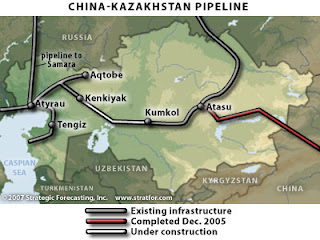
Kazakhstan’s KazStroyService has completed the construction of the Kenkiyak-Kumkol pipeline, giving China direct access to Kazakhstan’s oil provinces in western Kazakhstan, Reuters reported citing an announcement by KazStroyService.

KazStroyService reportedly successfully completed the first test oil shipment.

The Kenkiyak-Kumkol link is the third part of the so-called Kazakhstan-China pipeline which runs from Atyrau near the Caspian Sea to Alashankou in China’s northwestern Xinjiang region. The first stage of the project was completed in 2003 and runs westward across Western Kazakhstan from the oil fields of the Aktobe region to Atyrau. This line will be reversed when all stages are complete. The second stage from Atasu, in northwestern Kazakhstan, to Alashankou was completed in 2006. The newly completed Kenkiyak-Kumkol pipeline will connect the two links and will give China access to CNPC’s Aktobe and Kumkol fields and the newly acquired MangistauMunaiGas upstream assets.

Kazakhstan and China agreed to build the 3,000 km pipeline in 1997 and have said they would later double the capacity of the combined pipeline from the current 10 million tons a year.

China extended a $10-billion loan to Kazakhstan in April in exchange for greater access to the country’s hydrocarbon wealth. Already, with CNPC’s recent purchase of a 50-percent stake in MangistauMunaiGas, China’s share in Kazkahstan’s oil production amounts to 22 percent, a local financial newspaper reported recently citing government data.

China is also building a pipeline to import up to 40 billion cubic meters of Central Asian gas a year. The link originates in Turkmenistan and goes through Kazakhstan and Uzbekistan.
(Silk Road Intelligencer)

6/27/2009

CHINA CHOOSES TURKMENISTAN (La Cina sceglie il Turkmenistan)


China National Petroleum Corporation signed a 30-year deal to increase purchases of natural gas from Turkmenistan by 30 percent, Chinese media reported - a landmark agreement for Beijing as it competes with Moscow for access to Central Asia's energy wealth.

"This agreement is very important for ensuring a stable, long-term and adequate supply of gas for this pipeline," Chinese Vice Premier Li Keqiang said at an official signing ceremony, according to the state-run newspaper Neutral Turkmenistan.

Li Keqiang met with his Turkmen counterpart to sign the contract, which increases gas deliveries to 40 billion cubic meters (52 billion cubic yards) annually, the newspaper reported.

The deal comes amid strained relations between Turkmenistan and Russia, which usually buys most of the Turkmen gas for onward sale in Ukraine and Europe.

Turkmenistan lashed out against Russia following an explosion in April at a gas pipeline linking both countries, and it appears Moscow underestimated the fallout from that event, notes U.K. newspaper The Guardian.

With the agreement, China has moved one more step along its bid for Central Asia’s energy resources — and ultimately toward expanding its geopolitical influence over the wider region.

Moscow, previously a major purchaser of Turkmen gas, could be losing out to cash-rich China in the race to secure energy commitments in Central Asia.

Earlier this year, Russia moved to reduce its gas imports from Turkmenistan because of plunging demand and prices in Europe.

China sees Turkmenistan as a more politically reliable supplier than Russia, which has a well-known tendency to use energy as leverage for geopolitical concessions. Furthermore, pre-existing infrastructure in Turkmenistan means the Turkmen deal could prove cheaper than the Russian deal, even if Turkmen natural gas is more expensive. And finally, China wants access to Central Asia’s energy, and Turkmenistan is a critical piece of the pie.

Meanwhile, China appears ready to invest some $3 billion to develop the South Yolotan gas field, one of the world's largest as Russian gas monopoly Gazprom announces a 30 percent cut in capital investments.

Turkmenistan holds more than 700 trillion cubic feet of estimated natural gas reserves.

Work on a 7,000-kilometer (4,300-mile) pipeline from Turkmenistan to China is expected to be finished by the end of the year.
(MosNews)