Russia's Gazprom said construction
would begin this week on the underwater section of its South Stream
pipeline, which will carry natural gas beneath the Black Sea and into
the European Union.
But is this really the case?
Gazprom CEO Aleksei Miller announced last month that the final
investment decision for the project had been reached. Miller attended a
groundbreaking ceremony near the town of Anapa on Russia's Black Sea
coast on December 7.
However, as Johnatan Stern,
head of the Natural Gas Research Program at the Oxford Institute for
Energy Studies notes, Gazprom hasn't yet ordered pipe or organized the
lay barge for the pipeline and "cannot start laying the offshore section
until 2014 [at the] earliest."
Moreover, EU officials say a final route has yet to be submitted to
Brussels and likely won't have final approval for at least another year.
RFE/RL has also learned that EU Energy Commissioner Guenther Oettinger
declined an invitation to attend the groundbreaking, citing previous
commitments.
Marlena Holzner, the spokeswoman for the EU energy commissioner, says
this means that a final investment decision on South Stream -- a phase
after all designs and studies have been completed and official approvals
are in hand -- isn't even in sight.
"We have no concrete information that, indeed, the final investment
decision on South Stream has been taken already because normally, if you
use this term in a general sense, you would have different things
established before you can say it's a final investment decision,"
Holzner says. "And one is that you have the route.
"To the European Commission, it has never been communicated that there
is a final route. That means where South Stream starts, where it ends,
and which countries the exact route goes through. That has not been
done," she continues. "There is no environmental impact assessment for
the whole route. As far as we can see it, we don't regard this as a
final investment decision."
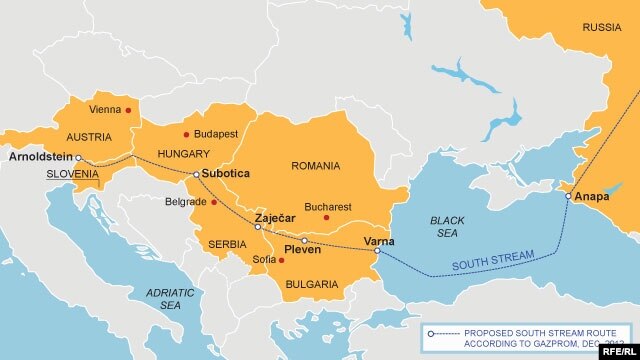
The proposed South Stream pipeline route, according to Gazprom
Gazprom says South Stream will pass through Turkish waters to Bulgaria,
then continue on through Serbia, Hungary, Slovenia, and Austria to tie
in with the distribution network of the multinational Eni in northern
Italy.
Officials in Brussels say they see South Stream's current status as
moving from the "conceptual design and feasibility" stage to the
"front-end engineering and design" phase.
In the latter phase, EU legislation requires numerous tasks that need
approval from regulators in each country along the route and from the
European Commission itself.
Russia says it has concluded intergovernmental agreements needed with
each EU country involved, but the European Commission hasn't yet seen
them all.
The deadline for EU states to submit those documents to Brussels is
February 16, 2013. The commission then has nine months to assess the
agreements and raise its doubts and concerns.
A detailed plan for the entire route must be submitted to Brussels,
which also must approve environmental and social impact studies by
national regulators in each EU country.
A "transboundary assessment" is also required, with input from EU states
adjacent to the route. All studies require consultations with the
public and authorities in each country and could take more than a year
to complete.
Moreover, the offshore section of the pipeline entering Bulgaria must
undergo an EU environmental-impact study to ensure it complies with
environmental directives.
Russian-European Chamber of Commerce President Sergei Shuklin confirmed
that the December 7 ceremony at Anapa will mostly be a ribbon-cutting
affair without underwater construction activity.
"Yes, yeah, I agree with that. But it starts," Shuklin said. "Actually,
by this action, Russia showed they are serious about this project. They
are just going to make it happen. I'm pretty sure.... So they will have
the first communications with the European Commission, with the
governments of the countries participating in this project. So
everything will be concluded [according to EU legislation], especially
[since] Russia just became a member of the World Trade Organization."
So why did Gazprom rush to make its announcement?
Shuklin suggested it could be related to a probe launched in September
by the European Commission into allegations that Gazprom engaged in
anticompetitive practices in Central and Eastern Europe.
"Russia was actually surprised with the action related to Gazprom," he
said. "And so probably, one of the reasons was, 'Yeah, let's just do it
our way. We know people from the countries where we will build the pipe,
and at this point, deal less with the European Union government.'"
Robert Cutler,
a research fellow at Carleton University's Institute of European,
Russian, and Eurasian Studies in Canada, maintains that Gazprom's push
to announce the start of construction work on South Stream could also be
related to domestic politics.
"On live Russian television, [President] Vladimir Putin gave [Prime
Minister] Dmitry Medvedev a direct order: Construction of the pipeline
should begin by the end of 2012," Cutler said. "There's a certain amount
of prestige domestically invested now in producing some sort of result,
even though physical construction of the pipeline probably was not in
the cards then and certainly is not now.
"If Putin gives this order and Medvedev says, 'We'll do it,' but it
doesn't end up happening, it raises questions domestically about their
authority within the factions in the Kremlin and about Gazprom's
credibility overall internationally."
According to Cutler, another reason is to give the appearance that South
Stream is progressing faster than the Nabucco pipeline, a rival
U.S.-backed project aimed at reducing Europe's dependence on Russian gas
by linking the Caspian region and the Middle East to EU markets.